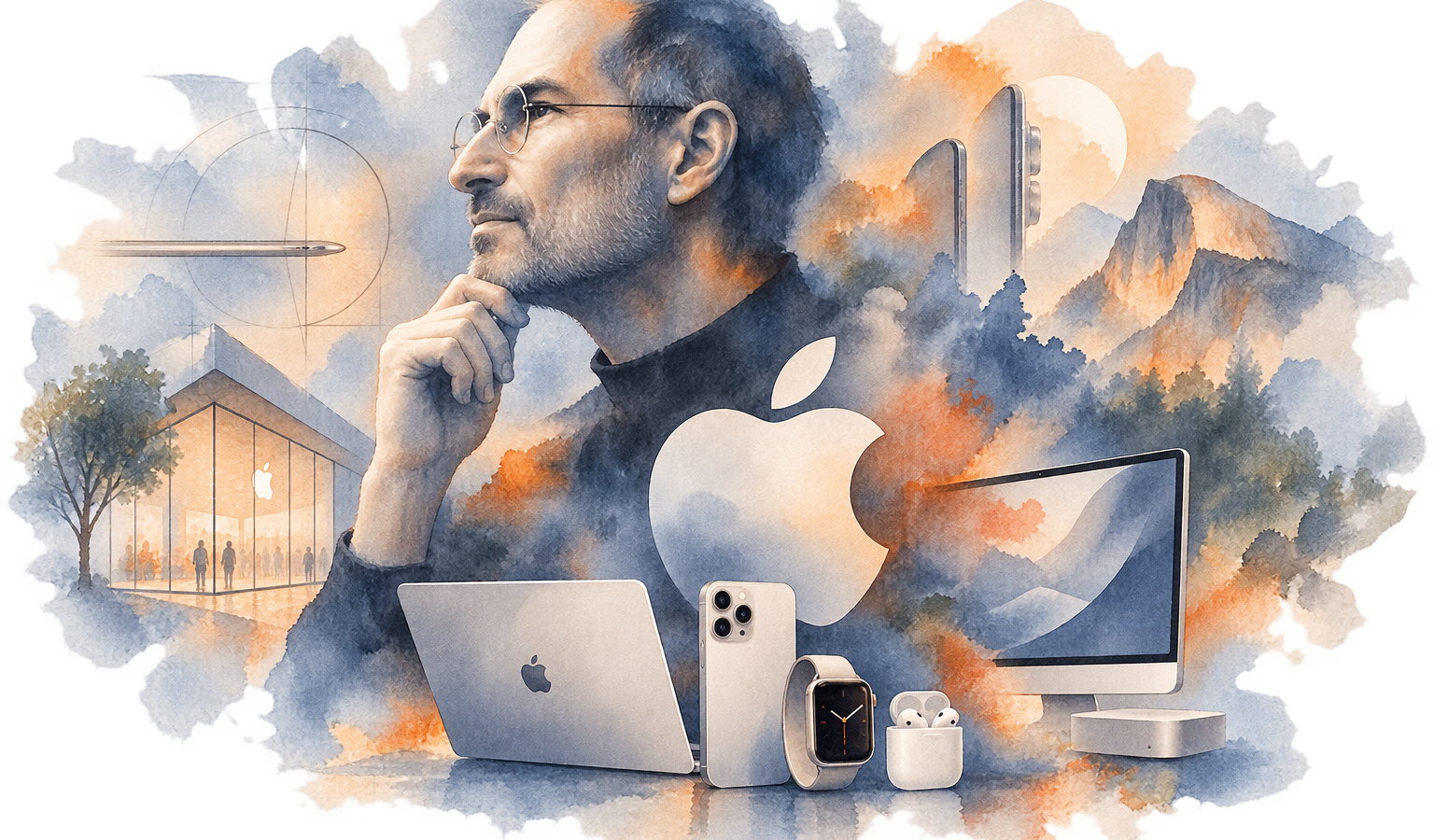
Apple is usually discussed through products.
A new iPhone is judged by its camera. A Mac is compared through performance, battery life and price. An operating system update becomes a list of features, while a product launch is reduced to a question that appears every year: is this version worth buying?
That discussion is understandable, but it misses the more interesting story. Apple does not merely produce devices. It advances a particular idea of what technology should be, how people should interact with it and how much control a technology company should retain in order to create a coherent experience.
The philosophy of Apple can be recognised in almost everything the company builds. It appears in the absence of visible complexity, in the close relationship between hardware and software, in the careful control of applications and accessories, and in the assumption that most users would rather trust a designed experience than manage every technical decision themselves.
This philosophy has produced some of the most influential consumer technology ever made. It has also created one of the most controlled ecosystems in the industry.
To understand Apple, it is therefore not enough to ask whether its products are good. The more revealing question is this: what does Apple believe technology is for, and what kind of relationship does it create between the product, the company and the person using it?
The Philosophy of Apple Begins With the Whole Experience
Most technology companies make choices about hardware, software and services. Apple treats those choices as parts of a single designed experience.
This distinction is central to the philosophy of Apple. A computer is not simply a collection of components, and a phone is not merely a platform on which unrelated technologies happen to meet. Every part of the system contributes to what the product means and how it feels to use.
The enclosure, operating system, application interface, processor, packaging, retail environment and customer support are presented as parts of the same idea. Apple wants the transition between them to feel deliberate rather than accidental.
This is why specifications alone rarely explain the appeal of an Apple product. A competing device can have more memory, a larger battery or a feature that Apple does not offer. Yet the Apple product may still feel more complete because the company has decided how its individual elements should work together.
The result is not always technically superior. It is often narratively clearer.
The product communicates what it expects from the user. Important functions are made visible, secondary decisions are hidden and interactions tend to follow patterns shared across the ecosystem. Apple’s Human Interface Guidelinesformalise many of the principles developers are expected to follow when creating software for its platforms.
Consistency reduces the amount of attention required to operate a device. Once users learn the logic of one part of the ecosystem, they can often recognise it elsewhere. Technology recedes slightly, allowing the task to move forward.
This is one of Apple’s most successful ideas: the quality of technology should not be measured only by what it can do, but by how little unnecessary thought it demands while doing it.
Design Is Not Decoration
Apple’s design reputation is often reduced to thin devices, clean lines and carefully selected materials. That interpretation treats design as an aesthetic layer placed over technology after the important engineering work has been completed.
Apple’s philosophy suggests the opposite. Design is the process through which the product’s purpose is defined.
A well-designed object does not merely look coherent. It tells the user what is important, what can be ignored and which actions are possible. Every visible option is an invitation to make a decision. Every removed option is a decision the designer has already made on the user’s behalf.
This helps explain Apple’s long preference for reducing visible complexity. Ports disappear, physical buttons are simplified and settings are organised around the experience Apple expects most people to want. The company often appears willing to remove familiar elements before every user is ready to abandon them.
Sometimes this produces genuine progress. Removing outdated conventions can make space for better interactions. At other times, simplification transfers power from the user to the manufacturer. A sealed device may look more elegant and resist dust or water more effectively, but it can also be harder to repair, modify or keep in service.
Design therefore carries a political dimension, even when the object appears neutral. It determines which freedoms are visible and which are unavailable.
As explored in _TECHDOGMA’s central essay on why technology is never neutral, every technological system reflects assumptions about behaviour and authority. Apple’s design is no exception. Its simplicity is real, but that simplicity is created through an unusually high degree of control.
Simplicity Requires Someone to Make the Decisions
“Simplicity” sounds universally desirable. Few people ask for software that is more confusing, hardware that is more difficult to configure or an interface that requires a manual for ordinary tasks.
But simplicity does not mean the absence of decisions. It means that many decisions have been made before the product reaches the user.
Apple decides which technologies are exposed, which are hidden and which are excluded completely. It determines how applications are distributed, what developers may access, how devices communicate and how deeply users can modify the system.
For most people, this can be a reasonable exchange. Not everyone wants to maintain an operating system, investigate application permissions or choose between several competing technical standards. A coherent default can protect users from complexity that offers little practical value.
The philosophical problem begins when a useful default becomes the only permitted choice.
There is an important difference between saying, “This is the experience we recommend,” and saying, “This is the only experience the system will allow.” Apple frequently operates closer to the second position than companies whose platforms are designed around openness and user modification.
That approach makes its products easier to support and more predictable to secure. It also means that users must trust Apple’s judgement long after the original purchase.
The company is not merely selling a tool. It is offering to manage part of the user’s technological life.
The appeal of this arrangement depends on trust. If Apple makes thoughtful decisions, control feels like care. If its decisions conflict with a user’s interests, the same control begins to feel restrictive.
Simplicity and authority are therefore not opposites. In Apple’s ecosystem, they are often two descriptions of the same design choice.
Hardware and Software as a Single Idea
One of Apple’s defining beliefs is that hardware and software should be developed in close relationship.
This sounds obvious today, particularly after other technology companies adopted similar approaches. Historically, however, the personal-computer industry often treated hardware manufacturers, operating-system developers and application creators as separate layers.
The open model encouraged variety. Users could combine components, choose between manufacturers and adapt their systems to specific needs. It also created inconsistency. Drivers failed, interfaces differed and responsibility for a problem could be passed from one company to another.
Apple chose vertical integration.
By controlling the device, operating system, essential services and increasingly the processor itself, Apple can optimise the whole system around a narrower set of possibilities. Features can be designed with knowledge of the exact hardware on which they will run. Security protections can extend from the processor to the application layer. Battery life and performance can be managed as parts of the same engineering problem.
The advantages are substantial, but integration has another effect: it makes each individual Apple product more valuable when surrounded by other Apple products.
A phone works independently, but it gains additional capabilities near a Mac, tablet, watch, earbuds and cloud account from the same company. Files, passwords, messages, photographs and calls move between devices with very little configuration.
The ecosystem begins to function like a single distributed product.
This is one reason Apple’s closed model cannot be dismissed as mere restriction. Integration produces real convenience. The difficult question is whether that convenience gives the user more freedom or gradually makes alternatives less practical.
_TECHDOGMA’s comparison of open and closed ecosystems explores this trade-off in greater depth. Apple demonstrates both sides of it unusually clearly: integration can create an excellent experience while simultaneously increasing dependence on the company that controls it.
The Ecosystem Is Designed to Make Leaving Feel Irrational
Apple does not need to make departure impossible. It only needs to make staying feel easier.
Each additional product strengthens the relationships between the others. A watch may depend on the phone. Purchased applications may not exist on another platform. Cloud photographs, passwords, messages and subscriptions accumulate around a single account. Accessories connect automatically because the ecosystem already knows who owns them.
No individual feature necessarily traps the user. Together, they create switching costs.
A person considering another phone is no longer comparing two phones. That person may be comparing one device with an entire network of habits, purchases, accessories and relationships. Leaving means reconstructing parts of a digital life that have become almost invisible through routine.
This is the sophisticated form of ecosystem control. It does not primarily operate through prohibition. It operates through accumulated convenience.
The user can leave, but the practical cost grows over time.
This does not mean Apple users are manipulated into staying against their judgement. Many remain because the products continue to work well, support is reliable and competing systems do not offer enough value to justify the disruption. Loyalty based on a consistently good experience is not irrational.
Still, the design of the ecosystem changes the conditions under which that judgement is made. The more a person invests in the system, the less each future purchase resembles an independent choice.
A new Apple device is evaluated partly by how naturally it joins what the user already owns. A competing product must be significantly better because it must also compensate for everything that becomes less convenient after the switch.
The ecosystem does not merely connect products. It reshapes the meaning of choice.
Control as a Method of Quality
Criticism of Apple often begins with the word control. The company controls its platforms, application distribution, hardware compatibility, interface conventions and many of the commercial relationships inside its ecosystem.
That control is real. But describing it only as a business strategy overlooks its role in Apple’s idea of quality.
An open system permits participants to pursue different goals. Developers, manufacturers and users can modify their part of the system without waiting for a single authority. This can encourage innovation, experimentation and freedom.
It can also create fragmentation.
Apple’s approach begins with the belief that somebody must remain responsible for the experience as a whole. If every participant can change essential behaviour independently, consistency becomes more difficult to protect. From this perspective, control is not an unfortunate side effect of design. It is what makes deliberate design possible.
The App Store illustrates the tension. Central review can reduce exposure to obviously malicious software, create consistent payment mechanisms and give less technical users a clearer source of applications. The same system allows Apple to determine which business models, technologies and forms of software may reach users through its platform.
The company can describe these rules as protection, while developers may experience them as gatekeeping. Both interpretations can be true.
The philosophical divide concerns who should make the final decision. Apple generally believes the platform owner must retain enough authority to protect the integrity of the system. More open traditions argue that the person who owns the device should possess greater authority over what it runs.
This disagreement is larger than any single store policy. It reflects two different ideas of technology: one built around managed coherence and another built around user sovereignty.
The Apple User Is Part of the Design
Apple’s philosophy does not end with the object. It also creates a narrative about the person using it.
Advertising rarely presents the Apple user as someone fascinated by configuration menus or technical specifications. The user is creative, expressive, productive and independent. Technology does not define this person; it quietly enables what that person wants to accomplish.
This narrative is powerful because it turns reduced complexity into identity. The user does not need to manage the machine because attention belongs elsewhere—to music, photography, writing, work or communication.
Apple therefore sells more than ease of use. It sells the idea that technological competence does not have to look technical.
Consumer research has long examined how products and brands become parts of identity. Research into self-brand connections suggests that people can use the symbolic meaning of brands to construct and communicate ideas about themselves.
This does not mean every Apple customer treats a phone or computer as a personal philosophy. Many simply choose familiar products that meet practical needs. A company cannot manufacture loyalty from symbolism alone if its products repeatedly disappoint the people using them.
Apple’s identity narrative works because it is reinforced by the experience. Consistent interfaces, recognisable materials, distinctive retail spaces and close integration make the brand’s values feel tangible.
The object becomes evidence of taste, but also evidence of belonging to a particular view of technology: that good tools should feel considered, understandable and complete.
This identity has a less flattering side. Brand preference can become social distinction. Criticism of a product can be interpreted as criticism of the person who chose it. Rational evaluation becomes more difficult when the brand is incorporated into the user’s sense of self.
The stronger the identity, the easier it becomes to defend the ecosystem rather than question it.
Belonging Without Membership
Apple does not operate a conventional membership community around its products. There is no formal identity that every customer must adopt.
Yet Apple has many characteristics associated with what researchers call a brand community: shared knowledge, rituals, historical stories and a sense of difference from people outside the group. The influential Brand Community study examined communities built around several brands, including Macintosh users.
The Apple community is unusual because much of its belonging occurs without direct organisation from Apple.
Users watch presentations, discuss rumours, compare interpretations of design changes and help one another solve problems. Product announcements become recurring cultural events. Older devices become symbols of particular periods in the company’s history.
Even disagreement follows familiar rituals. One group argues that Apple has lost its original direction. Another sees each removed port or redesigned interface as a necessary step forward. People debate what the company “would” or “would not” do as if Apple possessed a stable personality independent of its current leadership.
This is what a strong philosophy provides: a framework through which individual decisions can be interpreted.
When a company has no recognisable philosophy, each product stands alone. When a company has one, every product becomes evidence either that the philosophy remains alive or that it has been betrayed.
Apple benefits enormously from this attention. Its users do not merely consume finished products; they interpret the company’s decisions and maintain the meaning of the brand between launches.
The community also gains something. Shared interest creates genuine relationships, practical knowledge and collective memory. Commercially formed communities are not necessarily false communities.
The important question is whether belonging strengthens the user’s voice or makes criticism feel like disloyalty.
Privacy as Product, Principle and Identity
Apple’s privacy position demonstrates how a technical value can become part of a company’s identity.
Apple publicly describes privacy as a fundamental human right and presents it as a principle built into product development. Its published approach includes data minimisation, on-device processing, transparency, user control and security protections. These principles appear across Apple’s privacy materials and developer guidance.
The business model helps make this position possible. Apple earns a large part of its revenue through hardware and services rather than primarily through advertising based on detailed behavioural profiles. Economic incentives do not explain every privacy decision, but they shape which choices are commercially realistic.
Privacy also differentiates Apple’s products. It reassures customers while placing the company on a morally favourable side of a wider industry debate. Choosing an Apple device can therefore feel like choosing a more responsible relationship with technology.
The reality remains more complicated than the narrative.
A closed ecosystem can protect information by limiting access, but users must trust the company operating that ecosystem. Apple’s control can reduce opportunities for third parties to collect data while increasing the importance of Apple’s own policies, infrastructure and judgement.
Privacy features can provide meaningful protection without making the company beyond criticism. The claim should be evaluated through actual product behaviour, legal obligations and technical architecture, not accepted solely because it fits the brand’s identity.
This reflects the broader relationship between privacy and convenience. Users often surrender control because convenient products make that surrender difficult to see. Apple attempts to offer convenience while reducing some forms of data exploitation, but the user still operates inside a system whose boundaries are defined by Apple.
Privacy within a controlled ecosystem is valuable. It is not the same as independence from the ecosystem.
Accessibility Reveals the Strongest Side of Integrated Design
Control is easiest to criticise when it blocks modification or competition. Its advantages become clearer when a company uses integration to make technology accessible to more people.
Apple states that accessibility should be built into products rather than added later. Its accessibility approach includes features related to vision, hearing, speech, mobility and cognitive needs across multiple devices and operating systems.
Integrated development makes this possible at a deeper level. Accessibility features can interact with hardware controls, system applications, security mechanisms and developer frameworks. They do not have to depend entirely on separate software added after the product is finished.
This illustrates the strongest argument for Apple’s philosophy. When one organisation accepts responsibility for the whole experience, it can address needs that fragmented markets may neglect. A feature that is not immediately profitable as a standalone product can still become part of the platform’s basic design.
Accessibility also challenges the shallow definition of simplicity. A product is not truly simple if it works only for people whose bodies, senses and abilities match the designer’s assumptions.
Good design does not merely remove options. It makes complexity manageable for different kinds of users.
Apple’s success in this area does not erase other limitations, but it demonstrates why control cannot be evaluated as automatically good or bad. The ethical meaning of control depends partly on what the organisation does with it, whose needs it considers and whether users retain meaningful alternatives.
Digital Ownership Exposes the Limits of Apple’s Philosophy
Apple’s products are often physically refined but digitally conditional.
A user may own a device while licensing much of the software that gives it meaning. Applications, media, cloud data, activation systems and accessories can depend on rules that the company retains the power to change.
This is not unique to Apple. It is a defining condition of contemporary consumer technology. Yet Apple’s deeply integrated model makes the tension especially visible.
The same connection that allows devices to work together can make them difficult to separate. The same security architecture that protects users can limit independent repair or software installation. The same account that makes services effortless can become essential to purchases and personal data.
As explained in _TECHDOGMA’s pillar guide to digital ownership, payment does not always provide lasting control. Digital ownership depends on the ability to retain access, export data, repair hardware and continue using a product without permanent permission from the original seller.
Apple generally prioritises the integrity of the system over the owner’s unrestricted authority to modify it.
For many users, that trade produces a safer and more reliable experience. For others, it weakens the meaning of ownership. A device that works beautifully but only within approved boundaries remains partly governed by the company after it has entered the user’s home.
This may be the central contradiction in Apple’s philosophy: the company creates personal technology through impersonal control.
The product feels intimate because Apple manages so much of what happens behind it. But the more successfully the system anticipates the user, the less often the user is invited to determine how the system itself should work.
Apple and the Alternative Philosophy of Mozilla
Apple is not the only technology organisation to treat values as part of product design.
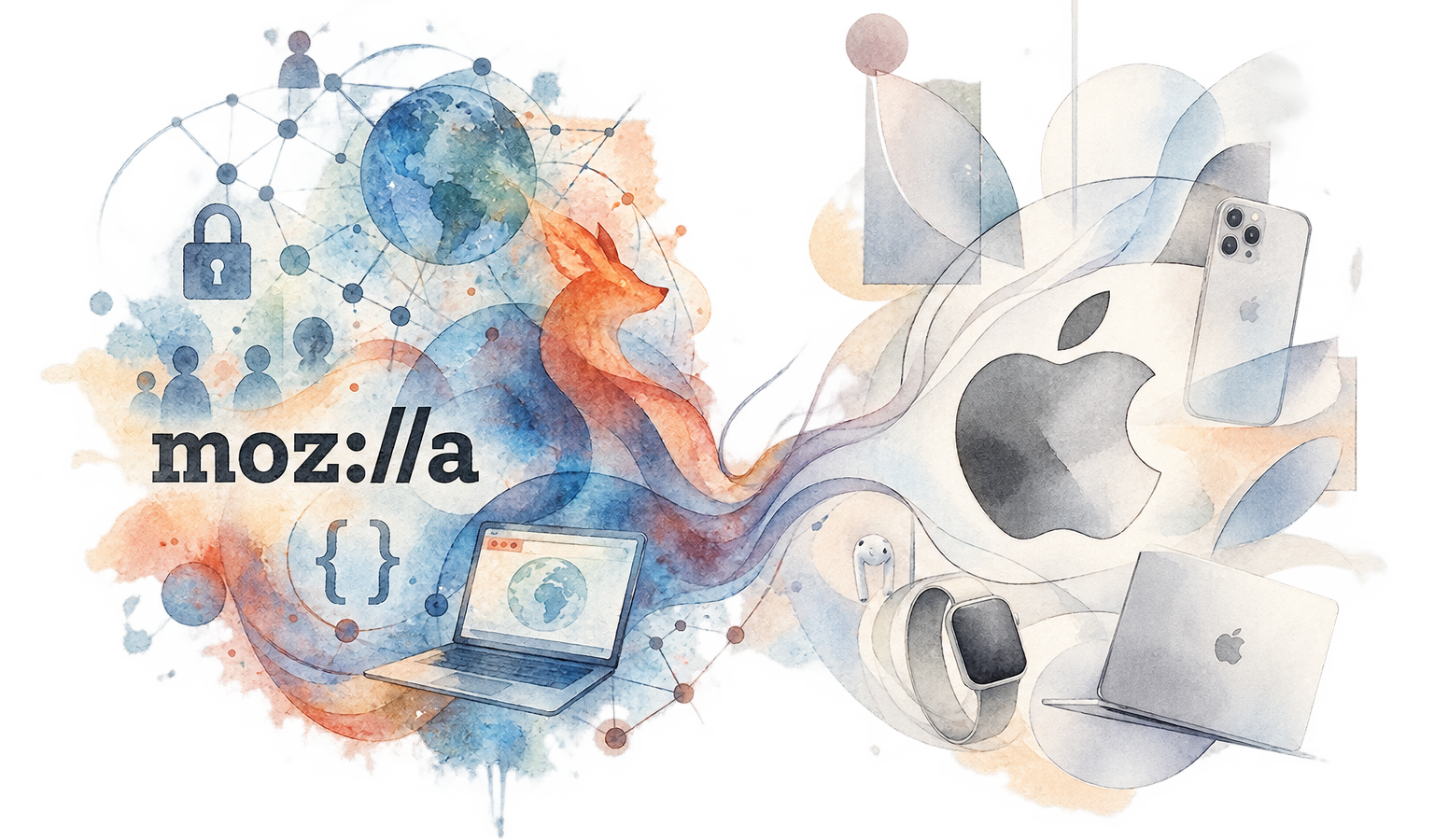
Mozilla represents a contrasting philosophy. Its historical mission places greater emphasis on an open internet, public participation and limiting the power of dominant platforms. Apple places greater emphasis on an integrated experience protected by a central authority.
Both can speak about privacy and users. The meaning behind those words is different.
For Apple, protecting the user often means designing a controlled environment in which harmful or confusing possibilities are reduced. For Mozilla, protecting the user more often means preserving openness, standards and the ability to choose between independent participants.
Apple’s model resembles a carefully designed city managed by one institution. Mozilla’s model resembles shared public infrastructure governed through open rules. The first can be coherent, secure and pleasant. The second can preserve pluralism and prevent a single organisation from deciding how everyone must participate.
_TECHDOGMA’s comparison of Mozilla and Apple shows that neither model can be understood only through features. Each begins with a different answer to the question of trust.
Apple asks users to trust the designer.
Mozilla asks the technological environment to remain open enough that trust does not have to rest entirely with one designer.
Does Apple Empower Users or Manage Them?
The honest answer is that it does both.
Apple empowers users by reducing technical friction, protecting certain forms of privacy, integrating accessibility and making advanced technology understandable to people who do not want technology itself to become a hobby.
It manages users by restricting possibilities, controlling distribution, shaping default behaviour and making its products most valuable inside an ecosystem that it alone governs.
These outcomes are not accidental contradictions. They emerge from the same philosophy.
Integration creates both reliability and dependence. Curated software distribution creates both protection and gatekeeping. Simplification creates both clarity and reduced choice. A coherent ecosystem creates both convenience and lock-in.
Debates about Apple often fail because each side describes only one half of this structure.
Supporters point to the quality of the experience and reasonably ask why users should sacrifice reliability for theoretical freedoms they may never exercise. Critics point to platform control and reasonably ask whether unused freedom is still important because it limits what the company can impose in the future.
Both questions matter.
A freedom does not become meaningless simply because most people rarely use it. The ability to leave, repair, modify or install alternatives can discipline the organisation that would otherwise hold complete control.
At the same time, freedom that exists only in theory may offer little value to someone who cannot realistically exercise it. A technically open product can remain inaccessible, confusing or poorly supported.
The real challenge is not choosing between complete openness and complete control. It is determining how much control is necessary to create quality—and when that control begins serving the platform more than the person.
The Meaning of Technology According to Apple
Apple’s answer to the meaning of technology is remarkably consistent.
Technology should not demand attention for its own sake. It should translate complexity into understandable action. It should feel personal, coherent and intentional. The machinery should disappear behind what the person wants to create, understand or communicate.
This is a humane vision of technology.
It recognises that people do not exist to manage devices. A tool should respect attention, reduce unnecessary decisions and provide confidence that its parts will work together.
But Apple’s version of this vision contains a condition: the company must retain enough authority to define the experience.
The user receives simplicity but not complete sovereignty. The product becomes personal without becoming fully open. Technology disappears from view, while the institution controlling it becomes more deeply embedded in everyday life.
This is why Apple matters philosophically even to people who never purchase its products. The company has helped establish the expectation that technology should be experienced as a designed whole. Competitors have adopted integrated hardware, controlled stores, subscription services and ecosystems that connect devices through central accounts.
Apple did not invent every element of this model. It demonstrated how powerful the model could become when design, engineering, business and identity reinforced one another.
The company’s greatest product may therefore be neither the Mac nor the iPhone. It may be a particular relationship with technology: one in which complexity is exchanged for trust, freedom is balanced against coherence and control is made to feel like care.
The Philosophy of Apple Is a Philosophy of Trust
The philosophy of Apple cannot be reduced to minimalism, premium materials or attractive advertising. Its deepest principle is trust in designed systems.
Apple asks users to trust that fewer visible choices can produce a better experience. It asks developers to trust that platform rules protect the value of the ecosystem. It asks customers to trust that integration will remain more beneficial than the freedom to leave.
Much of the time, that trust has been rewarded. Apple’s products have made complex technologies approachable and pushed the wider industry to take design, accessibility, privacy and integration more seriously.
Trust, however, should never make scrutiny unnecessary.
A company that controls hardware, software, distribution, payments and cloud services occupies a position of extraordinary power. Good intentions and good design do not remove the need to examine how that power is used.
The most useful way to understand Apple is therefore neither admiration nor rejection. It is to recognise the bargain at the centre of its philosophy.
Apple offers technology that feels complete because the company refuses to surrender control over the whole. Users gain coherence, convenience and confidence. In return, they accept boundaries they did not design and cannot independently change.
For some people, that is the ideal technological relationship. For others, it is precisely the relationship technology should help them escape.
Either way, the question reaches far beyond Apple:
Should technology adapt to human freedom, even when freedom creates complexity, or should it be carefully shaped for people by institutions they are asked to trust?
Apple’s answer is visible in every product it makes.