There is something wonderfully uncomplicated about owning a physical book. Once you buy it, the relationship between you, the bookstore and the publisher is basically over. The book goes home with you, eventually finds a place on a shelf and may stay there for decades. You can lend it to a friend, give it away, sell it or forget that you even own it. Nobody needs to keep a server running or an account active for any of this to work, and the bookstore certainly doesn’t need to remember who you are.
Buying a Kindle book feels almost identical on the surface. You find a title, pay for it and within seconds it appears in your library. In many ways the experience is considerably better than buying a physical book. There is no waiting for delivery, no need to find more shelf space and no problem carrying a large library when traveling. If you replace your Kindle, your books don’t have to be packed into boxes and moved with everything else. You sign in and the library follows you.
I’ve always found that convenience difficult to argue against. Once a digital library becomes part of everyday life, going back to carrying several books around can feel unnecessarily cumbersome. Yet there is an interesting question hidden behind that convenience, and it begins with a word so ordinary that most of us barely notice it anymore. When Amazon says that we can buy a Kindle book, what exactly have we bought?
The answer is more complicated than it first appears, and it says something important about the way technology is changing our idea of ownership. Kindle is only one example, but it happens to be an especially useful one because books existed as things we clearly understood how to own for centuries before somebody turned them into files, accounts and digital libraries.
A Book Used to Be a Very Simple Kind of Property
Buying a printed book has never meant buying the work itself. If I purchase a copy of a novel, I haven’t acquired the copyright and I obviously can’t start printing thousands of copies under my own name. What I have bought is a particular physical copy, and ownership of that copy gives me a surprising amount of freedom that we rarely think about because it has always seemed completely normal.
I can keep the book for the rest of my life without maintaining a relationship with the company that sold it. I can lend it to somebody without asking permission, sell it at a second-hand bookstore or give it away. The original publisher can go out of business and the bookstore can disappear entirely, but neither event changes the book sitting on my shelf. Even the technology required to use it is rather dependable: assuming I can still read and there is enough light in the room, the book works.
There is also no meaningful distinction between having access to the book and possessing the copy. If the book is in my house, I have access to it. Nobody needs to verify the purchase again. There is no remote system checking whether my account is in good standing, and there is no software layer interpreting the rights attached to that particular copy.
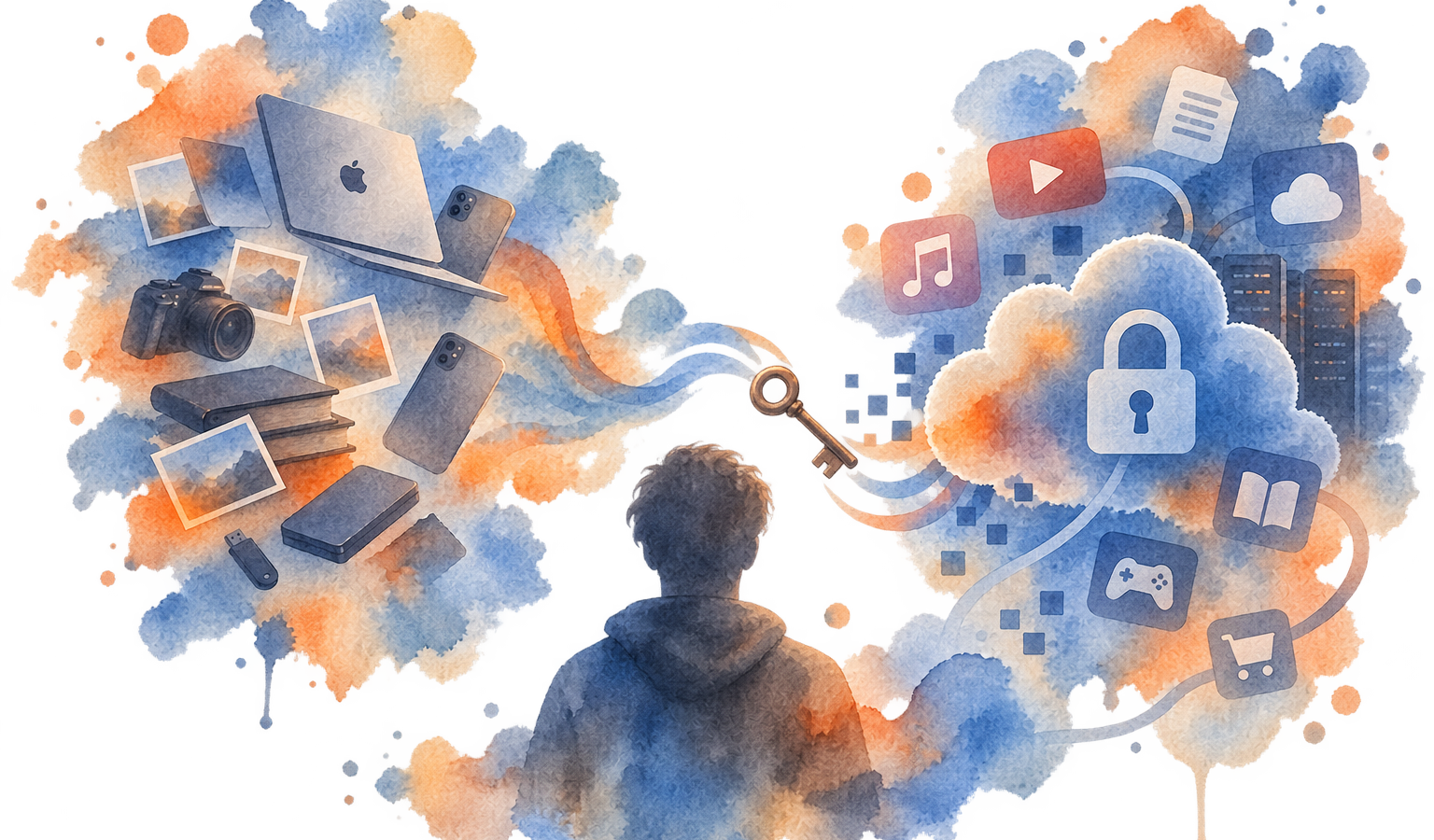
Digital books separate the content from that physical object, and this is where things become more interesting. Instead of taking home an independent copy in the traditional sense, a Kindle reader usually experiences a book through a much larger system involving an Amazon account, Kindle software, compatible devices, file formats and, in many cases, Digital Rights Management. None of those things necessarily make the experience worse. In fact, they are responsible for many of the reasons people prefer ebooks in the first place.
The difference is that the bookstore has stopped being merely a bookstore. It has become part of the infrastructure through which the product continues to exist for the customer. This is part of the much broader question of digital ownership: when the products we buy become software, files and cloud-based services, ownership increasingly depends on what the technology allows us to do with them.
Why Kindle Feels Like Ownership
It would be easy to turn this into an argument that Kindle readers don’t own anything and that physical books are therefore inherently superior. That makes for a provocative headline, but it doesn’t really capture how people use digital libraries or why the model became successful.
For most practical purposes, a purchased Kindle book behaves enough like a possession that readers naturally think of it as one. It appears in your library, you can return to it years later, and Amazon normally allows purchased titles to be downloaded again to compatible devices. A reader doesn’t wake up every morning wondering whether the novel on a Kindle is technically property, licensed content or something in between. You bought it yesterday, you’re halfway through chapter eight today, and that is usually all that matters.
There are also forms of freedom that a digital library provides which a physical collection cannot easily match. Losing a paperback on a train generally means buying another copy. Losing a Kindle does not mean losing the entire library stored through the account. A reader can move between devices, synchronize reading progress and carry hundreds of books without carrying hundreds of physical objects. Those aren’t minor benefits; they fundamentally improve reading for people who value portability and convenience.
Search is another small example that becomes surprisingly difficult to give up. Looking for a particular sentence in a printed book can mean trying to remember which chapter it appeared in and flipping through pages until you find it. An ebook can search the entire text in seconds. Notes and highlights can be collected without covering pages in ink, font sizes can be changed, and a large novel weighs exactly as much as a short one.
None of this has much to do with ownership in the traditional sense, but it helps explain why readers accept a different relationship with digital books. The digital version does things that the physical object cannot do, and those capabilities come from the very technological infrastructure that also makes the book more dependent on a platform.
The philosophical problem begins only when we notice that some of this convenience comes from that dependence. The same infrastructure that makes a library easy to recover, synchronize and manage also means that the relationship between reader and book can involve rules that simply don’t exist when a paperback changes hands. It is another example of the trade-off between privacy, convenience and user control that appears throughout modern digital products.
Ownership and Access Are Starting to Look Similar
One reason digital ownership is difficult to discuss is that modern platforms have blurred a distinction that used to be much clearer: the difference between owning something and having access to it.
Netflix makes the distinction obvious. Nobody subscribes to Netflix believing they own the films in its catalog. The monthly payment buys access to a service, and everyone understands that titles can appear and disappear while the subscription continues. Spotify works in much the same way. The catalog is enormous, but the listener isn’t building a personally owned record collection every time a song is saved to a playlist.
Digital stores are more complicated because they retain the language and experience of traditional retail. There is still a price attached to an individual product, there is still a Buy button, and the purchased item enters a personal library rather than a general subscription catalog. Everything about the interface tells us that this transaction belongs to the familiar world of ownership.
The technology underneath can tell a more complicated story.
This doesn’t mean that a Kindle purchase is simply a subscription disguised as a sale. It isn’t. The point is that digital products allow many different combinations of ownership, licensing and access that physical retail rarely needed to distinguish. A downloadable DRM-free ebook, a DRM-protected ebook, a Kindle Unlimited title and a paperback can all contain exactly the same words while giving the reader very different relationships with the copy.
That is why arguments about whether we “really own” digital products often go in circles. The word ownership is being asked to describe several different technological arrangements at once.
DRM Makes the Difference Easier to Understand
Digital Rights Management is probably the clearest example. DRM exists largely because a digital book is fundamentally different from a printed copy when it comes to reproduction. A physical book can certainly be copied, but doing so takes effort. A digital file can potentially be duplicated perfectly and distributed almost instantly, so publishers have obvious reasons to want some control over how commercial ebooks are copied and shared.
The problem is that DRM does more than discourage unauthorized copying. It can also determine what legitimate customers are able to do with something they have paid for. Depending on the title and the system being used, the reader may not have the same freedom to move a book between unrelated applications, make independent backups or continue using the file entirely outside the ecosystem where it was purchased.
This is where Kindle book ownership starts to look different from ownership of a paperback. The issue isn’t that one is real and the other is fake. They simply give the buyer different sets of rights and conveniences. A paperback offers enormous independence once the transaction is complete, while a managed digital book can offer much greater convenience as long as the surrounding technological system remains part of the relationship.
There is another subtle difference here. With a physical book, most restrictions are legal. Copyright law tells me what I am allowed to do with the work, but the book itself does not enforce those rules. Technology changes that relationship because restrictions can be built directly into the product. Software can decide whether a file opens, which application can read it or whether it can be copied in a particular way.
That difference between a rule written in law and a rule enforced by code is easy to overlook, but it matters. Software doesn’t merely describe what a user is supposed to do; it can define what the user is technically capable of doing in the first place. In that sense, DRM is not just a copyright tool. It is part of the design of the ownership relationship.
For years, Kindle was an especially useful example of this tension because Amazon built an exceptionally convenient reading ecosystem while keeping much of the experience closely connected to Kindle hardware, applications and formats. That made the trade-off relatively easy to see: readers gained a smooth digital library while giving up some of the independence that came naturally with physical books.
In 2026, however, Amazon made that comparison a little more complicated.
Kindle Ownership Changed in 2026
Since January 20, 2026, Amazon has allowed verified purchasers to download EPUB and PDF files of Kindle books that publishers offer without DRM. According to Amazon’s current Kindle publishing documentation, publishers can choose whether to apply Digital Rights Management to their ebooks, and that choice now directly affects whether customers can download EPUB and PDF copies of purchased titles.
This is an important distinction because an ordinary DRM-free EPUB can exist independently of a Kindle device or application. A reader can store a personal backup and use the file with other compatible reading software instead of relying entirely on Amazon’s ecosystem. The customer still benefits from Kindle’s storefront and library while gaining a degree of independence that traditionally has been associated more closely with owning a local file.
That moves the experience considerably closer to what many people intuitively expect when they hear the word ownership. Amazon may still be the store where the transaction happens, but the purchased file no longer has to remain permanently attached to that store’s own reading environment. If another application can open the EPUB and the reader controls a local copy, the platform becomes less important after the purchase.
The catch is that this doesn’t apply equally to every Kindle book. Publishers decide whether DRM is enabled for their titles, and Amazon’s current documentation makes a clear distinction between DRM-free books that can be downloaded as EPUB or PDF and DRM-protected books that remain limited to Kindle applications and devices. Two people can therefore buy two different books from the same store and end up with rather different levels of control over what they purchased.
This also shows why digital ownership cannot be understood simply by looking at the button used to complete the transaction. Two products can both say Buy, cost roughly the same amount and appear in exactly the same Kindle interface while providing different levels of portability once the purchase is complete. The commercial experience looks identical even though the technological relationship is not.
That makes the Kindle example more useful, not less. Instead of asking whether ebooks are owned at all, we can ask a much better question: how much control should come with a digital purchase before we are comfortable calling it ownership?
What Happens When the Store Never Really Leaves?
The traditional bookstore has a surprisingly limited role in the life of a book. It helps the buyer discover the title, processes the transaction and then largely disappears. Digital platforms have discovered that they don’t have to disappear at all.
A platform can remain involved because it manages the account, stores the library, delivers updates, synchronizes information and provides the software through which the content is consumed. From the user’s perspective, this can be extremely useful. From a business perspective, it also changes the relationship dramatically because the store can remain part of the product long after the sale.
This is one reason ecosystems have become so important in modern technology. A company no longer needs to sell an isolated object and hope the customer returns someday. It can build an environment in which products work particularly well together and where leaving means giving up some of that accumulated convenience.
Kindle is hardly the most extreme example of this model, but it demonstrates it cleanly. A large Kindle library gives a reader another reason to buy the next Kindle. Familiarity with the software gives another reason to buy the next ebook from Amazon. Notes, reading progress and the convenience of having everything in one place make the ecosystem more valuable with every purchase.
There is nothing unusual about a company wanting customers to stay. Businesses have always tried to build loyalty. What technology changes is the depth at which that loyalty can be designed into the product itself.
That connects Kindle to the broader philosophy of open and closed ecosystems. Closed or tightly integrated systems often produce excellent experiences precisely because one company can control more of the relationship between hardware, software, content and services. The price of that integration is usually some reduction in portability or user independence.
Digital Ownership Isn’t Just About Books
The reason this question matters is that Kindle isn’t an unusual exception. It is part of a much larger change in the relationship between consumers and the products they pay for. Software, games, films, music and even some features inside physical devices increasingly depend on accounts, remote services, licenses or platforms that remain involved long after money has changed hands.
Twenty years ago, buying software usually meant taking home a disc and a license key. Today, many professional applications require an active subscription. Music collections that once consisted of records, CDs or locally stored files have largely been replaced by access to enormous streaming catalogs. Games can be purchased digitally while still depending on online accounts or servers. Films bought through digital storefronts live inside libraries that look permanent to the customer but remain technically connected to the platform providing them.
Games provide an especially interesting comparison because the physical object has almost disappeared while the language of ownership remains. A game can be listed in a digital library for years, yet its ability to function may depend on authentication systems, downloadable components or online infrastructure that the customer does not control. Again, this doesn’t mean the purchase has no value. It means the thing being purchased is no longer as self-contained as the cartridge or disc that once represented it.
Software has moved even further. In many categories, we have stopped pretending that the customer is purchasing a permanent copy at all. Subscription pricing makes the relationship explicit: pay while you need the software and lose access when the payments stop. Whatever one thinks about that business model, at least the distinction between ownership and access is relatively clear.
Ebooks occupy a more ambiguous position because they still resemble traditional products. A novel is not continuously improved by a development team and does not need a cloud server to tell its story. The underlying work can be perfectly static, which makes platform dependence feel less inevitable than it does with an online service.
That is precisely why Kindle is such a useful case study. It allows us to separate what digital technology genuinely requires from what platforms and publishers choose to implement.
The Word “Buy” Is Doing a Lot of Work
Perhaps the most interesting part of all this is that the language of shopping hasn’t changed nearly as quickly as the technology behind it. We still buy books, buy games and buy films even when those transactions give us very different rights from the physical purchases that originally gave the word its meaning.
This doesn’t mean companies should stop using the word, nor does it mean every digital transaction is secretly a rental. The reality is much messier. Some digital purchases provide downloadable, unrestricted files that can remain useful without the original seller. Others depend heavily on an account or platform. Many sit somewhere between those two extremes.
That is why thinking about digital ownership as a spectrum is more useful than arguing over whether something is truly owned. The important questions are practical ones. Can I keep an independent copy? Can I use it with software from another company? Does it continue working if I leave the platform? Can I transfer it to somebody else? How much control does the seller retain after I’ve paid?
Those questions reveal far more than the word buy on a checkout page. A DRM-free ebook stored locally offers a different form of ownership from a title that exists only through a managed platform, even if both were purchased rather than rented. A piece of software with a perpetual offline license differs from a cloud subscription. A downloaded music file differs from an album saved inside a streaming app.
Ask the same questions about a paperback and the answers are obvious. Ask them about a Kindle book and the answers depend on how that particular book is distributed. Ask them about a game, a movie or a software subscription and the answers change again. The word buy has remained remarkably stable while everything underneath it has become more complicated.
Control May Be a Better Measure Than Ownership
Perhaps we are approaching the problem from the wrong direction when we ask whether a digital product is truly owned. A more useful measure may simply be control.
The more control a customer has over a purchased product, the less important the original seller becomes after the transaction. A downloadable file that can be backed up, transferred between compatible applications and used without continuing authentication gives the buyer considerable independence. A product that requires a particular account, application and online infrastructure gives the platform a continuing role.
This doesn’t automatically tell us which product is better. There are good reasons to prefer systems that manage complexity for us. Most people don’t want to spend their evenings organizing ebook files, maintaining music libraries or backing up every piece of digital media they purchase. Platforms became successful partly because they solved problems that ordinary users were happy to stop thinking about.
The important distinction is whether convenience is an option or a requirement. A system that offers cloud synchronization while still allowing the user to keep an independent copy provides both convenience and control. A system that makes the platform the only practical route to the product asks for a larger trade.
That distinction reaches beyond ownership and into a much broader philosophy of technology. Technical architecture quietly establishes relationships of power. Whoever controls the account system, file format, authentication mechanism or distribution platform can influence what users are able to do with the technology they have paid for.
What Kindle Tells Us About the Future of Ownership
Kindle is easy to criticize precisely because Amazon has been so successful at making the underlying system disappear from everyday use. Most readers don’t need to understand DRM, licensing or file formats to enjoy a book, and they shouldn’t have to. Good technology often works by hiding complexity rather than forcing users to think about it.
Still, hiding complexity doesn’t make the choices behind that complexity irrelevant. When more of the things we value become digital, the distinction between owning something and having reliable access to it becomes increasingly important. A generation raised on subscriptions, cloud libraries and online accounts may develop a very different intuitive definition of ownership from someone whose music, books, games and software once existed primarily as physical objects.
Amazon’s 2026 change for DRM-free Kindle books is particularly interesting in that context because it moves in the opposite direction from the assumption that digital products must inevitably become more closed. Giving readers downloadable EPUB and PDF copies makes at least some Kindle purchases more portable and more independent. It suggests that a digital storefront doesn’t necessarily have to choose between providing a convenient ecosystem and allowing customers to take their purchases elsewhere.
There is a broader lesson here for technology companies as well. Users do not necessarily object to ecosystems, cloud services or integrated platforms. Most of us use them every day because they make technology easier. The tension begins when convenience becomes inseparable from dependence and when leaving a platform means losing practical control over things we thought we had bought.
Physical ownership solved that problem almost accidentally. Once an object left the store, the technology of the object itself usually prevented the seller from remaining involved. Digital products have removed that limitation, which means companies now have to make deliberate choices about where their control ends and the customer’s begins.
Perhaps this is why Kindle is more interesting than it initially appears. It isn’t simply a story about ebooks or Amazon, and it isn’t really a battle between paper and screens. It is a small example of a much larger transition in which ownership is being redesigned by software.
The Kindle didn’t make ownership disappear. It showed us that the familiar word can describe very different relationships depending on who controls the file, the platform and the technology around it. As more of our possessions become digital, understanding those differences may matter far more than deciding whether an ebook can ever feel quite as permanent as a book sitting quietly on a shelf.