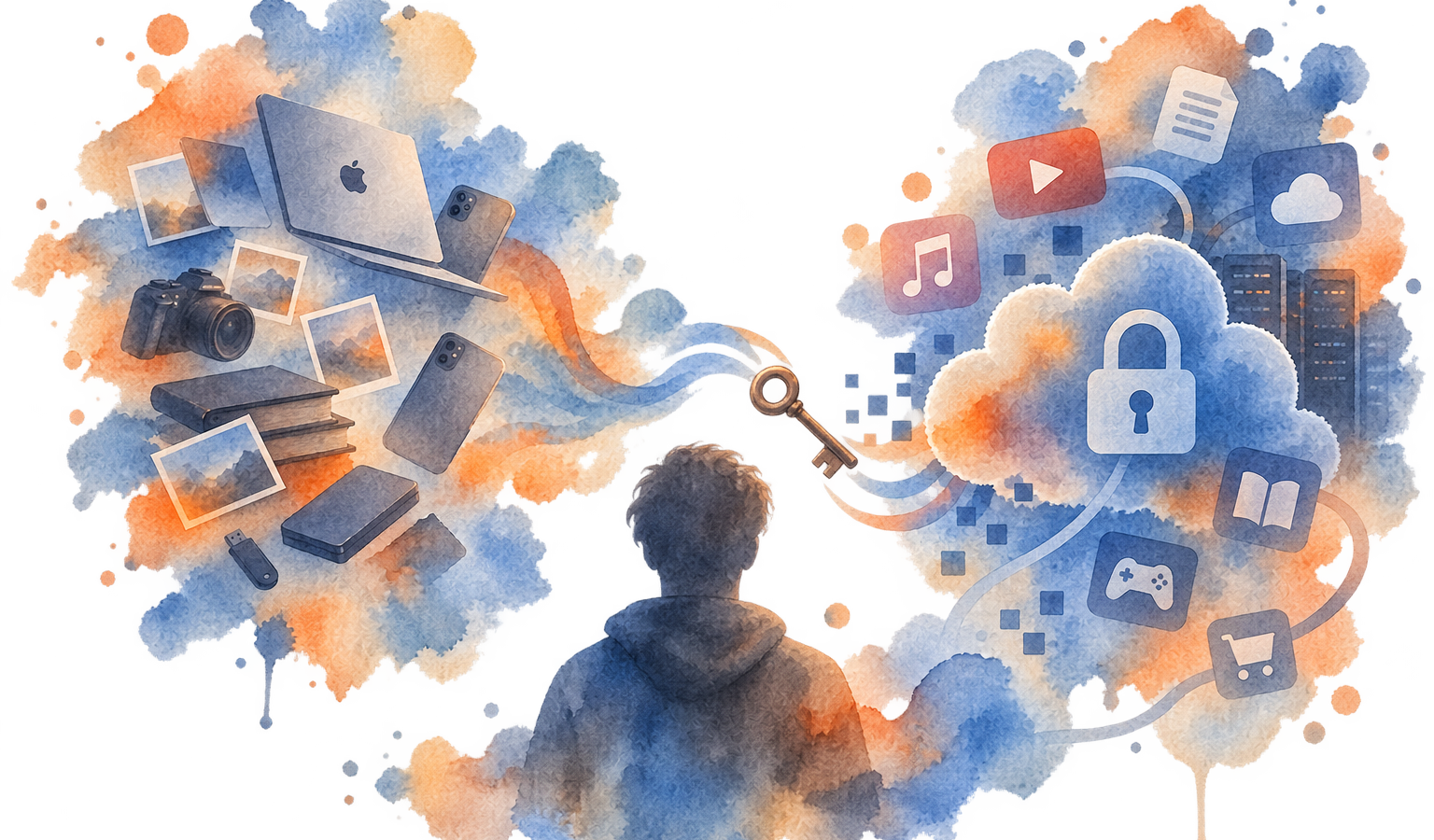
The word buy used to settle the matter.
You bought a book, took it home and placed it on a shelf. You could read it, lend it to a friend, write notes in the margins or sell it years later. The publisher could not remotely remove a chapter, require you to create an account or decide that your copy had reached the end of its supported life.
Digital ownership is different.
We buy games that require online authentication, ebooks governed by revocable licences, software that stops working when a subscription ends and smart devices that depend on servers we do not control. The payment is real, but the ownership is often conditional.
This does not mean every digital product is a scam or that subscriptions are inherently bad. Cloud services offer collaboration, synchronisation and continuous updates that physical products cannot provide. The problem begins when the language of ownership promises permanence while the underlying technology delivers temporary access.
To understand digital ownership, we need to ask a more precise question: after paying for a digital product, what can we actually do without asking the seller for continued permission?
What Is Digital Ownership?
Digital ownership is the degree of lasting control a person has over a digital product, file, account, device or service.
That control can include the ability to access something without a permanent internet connection, keep a personal copy, create a backup, move data to another platform, modify a product, lend or transfer it, repair the device that runs it and continue using it after the original company changes direction.
Ownership has never meant unlimited freedom. Buying a novel does not transfer its copyright to the reader, and owning a film does not grant permission to distribute copies. Traditional ownership still places legal limits on what someone may do with a work.
What makes digital ownership unusual is that the seller can enforce additional restrictions through the product itself. A printed book cannot check whether its reader is signed in. A digital book can. A mechanical appliance does not usually need approval from its manufacturer every time it starts. A connected appliance may refuse to work if its account, application or remote server is unavailable.
Digital technology turns contractual rules into technical rules.
This is why digital ownership is not merely a copyright question. It is also a question of product design, platform governance, interoperability, data portability, repair and power. As discussed in _TECHDOGMA’s guide to the philosophy of technology, technology is never completely neutral. A system’s architecture determines who may act, who must ask permission and who can change the rules later.
Buying Access Is Not the Same as Owning a Copy
Many digital transactions resemble purchases on the surface. A product has a price, a button says “Buy” and the customer receives access after paying. The familiar language encourages us to interpret the transaction as ownership.
The agreement behind the button may describe something else.
Valve’s Steam Subscriber Agreement states that content and services are licensed rather than sold. It also explains that a licence does not give the user title or ownership over that content. Amazon uses similar language in its Kindle Store Terms of Use, where Kindle content is described as licensed, not sold.
These companies are not hiding the legal terms entirely. The information exists, but it lives inside agreements that few people read and that do not carry the same visual weight as the purchase button.
A licence is not automatically unreasonable. Software creators need rules against unauthorised distribution, commercial copying and abuse. A licence can also grant users valuable freedoms, as free and open-source software demonstrates.
The real issue is the gap between the expectation created by the interface and the rights granted by the agreement.
When a shop says rent, people understand that access is temporary. When a streaming service says subscribe, continued payment is clearly part of the arrangement. But when a platform says buy, most people reasonably expect something more durable than permission tied indefinitely to an account, server or company policy.
Digital ownership becomes difficult to evaluate because several very different transactions are presented through almost identical interfaces.
Ownership Is a Bundle of Rights
It is tempting to treat ownership as a simple yes-or-no condition: either you own something or you do not. In practice, ownership is better understood as a bundle of abilities.
A meaningful form of digital ownership usually includes several of the following:
- Access: You can use the product when you need it.
- Possession: You can retain a functional copy under your control.
- Permanence: Access does not depend entirely on the seller remaining in business.
- Portability: You can move your files or data to another compatible system.
- Transfer: You can give, lend or resell the product where the law permits it.
- Repair: You can maintain the hardware and software required to use it.
- Modification: You can adapt the product for personal use.
- Preservation: You can create backups and keep the product functional over time.
- Independence: Core functions do not require continuous approval from a remote service.
Very few digital products provide all these rights. The useful question is therefore not simply, “Do I own it?” A better question is, “Which parts of ownership do I have, and which remain under the company’s control?”
You may permanently possess an audio file but be unable to transfer the account through which it was purchased. You may own a smart thermostat as a physical object while depending on its manufacturer for remote functionality. You may control the content of a document but not the cloud application where it was created.
Digital ownership exists on a spectrum. Some products give users substantial independence; others offer little more than revocable access.
The Licence Hidden Behind the Buy Button
Software licences exist for legitimate reasons. Developers retain copyright in their work, platforms need rules for distributing it and users need clear permission to install and run it. The existence of a licence is not the problem.
The problem is that most consumer licences are not negotiated. They are presented as a condition of access after the product, platform or device has already become attractive to the user. The customer can accept the entire agreement or walk away.
In theory, consumers are informed. In practice, almost nobody evaluates several thousand words of legal language before downloading a game or opening an ebook. Even when people read the terms, they may not understand how those terms interact with account bans, server closures, mandatory updates or changes in platform policy.
The interface says what the user can do today. The licence often describes what the company may do tomorrow.
This imbalance matters because digital companies can modify products after purchase. Features can be removed, compatibility can change and an application can become dependent on a new account or subscription. The product is no longer a finished object crossing permanently from seller to buyer. It remains part of an ongoing relationship.
That relationship can be useful when it provides security patches and meaningful improvements. It becomes harmful when continuous control is used to narrow a product’s function, introduce restrictions or make previously purchased capabilities conditional on new payments.
A fair digital transaction should therefore make the limits of ownership visible before purchase. If the customer receives a temporary licence, the product page should communicate that as clearly as it communicates the price.
DRM: When a Licence Becomes Part of the Product
Digital rights management, usually shortened to DRM, refers to technologies designed to control access to digital content and restrict certain uses.
DRM can limit copying, require account authentication, control which devices may open a file or prevent modification. Publishers use it to reduce unauthorised distribution and protect commercial releases. From their perspective, a digital file can be copied perfectly and shared globally at almost no cost, so some technical protection appears necessary.
From the user’s perspective, DRM changes the character of ownership. The restriction is no longer merely written in a contract; it is built into the file, application or device.
The Electronic Frontier Foundation’s overview of DRM argues that these systems can interfere with otherwise legitimate uses of media and hardware. A person may have paid for a product and still be unable to create a practical backup, move it to another device or preserve access after the original platform disappears.
DRM also creates an uncomfortable asymmetry. It usually cannot guarantee that unauthorised copies will never circulate, but it can make lawful customers more dependent on the seller’s infrastructure. The person who acquired an unrestricted copy elsewhere may keep it, while the paying customer must maintain an account and compatible software.
That does not make every form of access control illegitimate. It does mean that DRM should be judged by more than its anti-piracy goal. We should also ask whether it respects ordinary, reasonable uses and whether the customer can retain access if authentication servers are eventually shut down.
A protection system that prevents copying for commercial distribution is one thing. A system that makes a purchased work unusable because a distant server no longer responds is something else.
Digital Ownership of Games
Games reveal nearly every tension in digital ownership at once.
A modern game may contain locally installed files, online multiplayer services, cloud saves, downloadable content, anti-cheat software, an account system and a store controlled by a platform owner. The player’s experience depends on several organisations continuing to cooperate.
For a purely online game, server dependence is part of the product. Nobody can reasonably expect a multiplayer service to operate forever without funding or maintenance. Yet many games contain single-player or local features that could continue working after online support ends. Whether those features survive depends on design decisions made long before the shutdown.
The same distinction applies to authentication. Occasional online verification may be intended to protect a release from unauthorised copying. Permanent verification makes continued use dependent on infrastructure that may not exist in ten or twenty years.
Digital storefronts also complicate preservation. A game can disappear from sale because music licences expire, a publisher changes strategy or rights become disputed. Delisting does not always remove the game from existing owners’ libraries, but it demonstrates that commercial availability is not permanent.
Physical games are not automatically safe either. Discs can deteriorate, hardware can fail and modern retail copies may require large downloads. The difference is that a physical copy can often be preserved, transferred or used without the retailer maintaining a personal account for its owner.
A stronger model of digital ownership would require publishers to plan for the end of commercial support. Offline modes, removal of unnecessary authentication and tools for community-hosted servers could allow a game to survive without requiring a company to operate its service forever.
The goal is not immortality for every server. It is a graceful end-of-life plan that respects the people who paid for the product.
Ebooks and the Difference Between a Book and a Service
An ebook looks like a book, but its ownership model may resemble a software service.
A printed book can remain readable for generations without permission from the publisher. An ebook may require a compatible application, an authorised account and a device supported by the platform. The text can be identical while the reader’s practical rights are completely different.
This difference affects more than permanence. Physical books can be lent, donated, resold and inherited. Those activities helped create libraries, second-hand bookshops and informal exchanges between readers. Digital licences often restrict the same behaviour because transferring a file can create an additional copy rather than move a single physical object.
That technical difference is real, but it does not settle the philosophical question. A digital work can be infinitely reproducible while still being sold through an ownership-like interface. The challenge is to protect writers and publishers without reducing every reader to a permanently supervised licensee.
DRM-free ebooks offer one possible balance. The customer receives a standard file that can be backed up and read with different applications, while copyright law still prohibits unauthorised commercial distribution. This model relies more heavily on legal and social rules than technical control.
It is not perfect, and it does not eliminate piracy. What it provides is resilience. If a bookstore closes or stops supporting a device, the reader’s library does not automatically disappear with it.
The important distinction is not paper versus screen. It is whether the reader controls a durable copy or merely maintains access through someone else’s system.
Music, Film and the Normalisation of Temporary Access
Streaming made temporary access feel normal.
That is not necessarily deceptive. A monthly streaming subscription does not pretend to transfer ownership of every song or film in its catalogue. Most users understand that access lasts while the subscription, licensing agreement and service remain active.
The problem is that subscription logic has spread beyond situations where it is genuinely useful. Features that were once included with a device can become paid services. Software that previously offered perpetual licences can move entirely to recurring payments. A product that once belonged to the buyer becomes an ongoing expense.
Subscriptions make sense when the service has continuing costs. Cloud storage, collaborative tools, live databases and professional support require infrastructure and labour. A recurring fee can provide predictable funding for maintenance and development.
But not every function requires permanent service from the seller. When a local feature is placed behind a subscription simply because billing is technically possible, the customer is no longer paying for continuous service. The customer is paying for the company not to disable an existing capability.
This is where ownership and convenience begin to conflict. Streaming offers enormous convenience, but a personal collection offers stability. Cloud software simplifies access across devices, but local files provide independence. As _TECHDOGMA’s examination of privacy and convenience argues, convenient systems often ask users to surrender forms of control that are easy to overlook at the moment of adoption.
The sensible response is not to reject subscriptions. It is to recognise what they are: access arrangements, not ownership.
The Cloud Turned Products Into Relationships
Before cloud computing became central to consumer technology, software usually ran on a device controlled by the user. A program might still have licence restrictions, but its essential functions could often continue without daily contact with the developer.
Cloud services changed that relationship.
The benefits are substantial. Documents can be synchronised across devices, teams can collaborate in real time and users do not need to maintain their own servers. Security updates can be deployed quickly, and demanding tasks can run on infrastructure more powerful than a personal computer.
The cost is dependency.
A cloud-based product can change its pricing, remove a feature, close an account or shut down entirely. Even when users retain legal rights to their content, they may lose the surrounding organisation: comments, links, metadata, version histories, automated workflows or relationships between files.
This is why exporting a pile of files is not always enough. True portability requires usable formats and enough context to rebuild the work elsewhere. A proprietary archive that only the original service can interpret does not provide meaningful independence.
Good cloud services recognise this risk. They offer clear export tools, standard formats, documented APIs and reasonable notice before major changes. Some also provide offline access or local copies of important data.
Poor services treat exit as a threat. They make importing simple and exporting difficult because trapped users are commercially valuable.
The ability to leave is one of the clearest tests of digital ownership. If changing platforms means abandoning years of work, relationships or purchases, the service does not merely provide convenience. It exercises structural power over its users.
Is Personal Data a Form of Digital Ownership?
People often say that companies “own” their data, but the legal and philosophical reality is more complicated.
Personal data is not always treated as property that can be owned in the same way as a laptop or a book. Privacy law tends to focus on rights and obligations: why information is collected, how it is processed, how long it is retained and what individuals may request.
Still, data is inseparable from digital autonomy. A person who cannot access, correct, delete or transfer personal information has limited control over their digital life.
The European Commission’s overview of individual data-protection rights includes the right to receive certain personal data in a structured, commonly used and machine-readable format. This principle of data portability can make it easier to move between services.
Portability, however, has limits. A downloaded archive may contain messages and photographs but not the recommendations, ranking systems, social context or platform relationships that gave the information meaning. Moving a list of contacts does not recreate a community. Exporting posts does not reproduce an audience.
Platforms create value by organising data, not merely storing it. Their power comes from controlling the surrounding system: discovery, identity, moderation, reputation and access to other people.
For this reason, digital ownership should include more than possession of raw files. It should involve understandable data practices, practical export tools and the ability to use alternative services without losing an entire digital history.
Privacy protects people from inappropriate observation and manipulation. Portability protects them from being trapped. Both are necessary parts of meaningful digital control.
Can You Own Hardware That Depends on Software?
A connected device may belong to you physically while remaining dependent on its manufacturer digitally.
This applies to phones, cars, cameras, appliances, medical devices, home-security systems and countless products marketed as “smart.” Their physical components can last for years, but applications, accounts and remote servers may determine whether important functions remain available.
Software dependency is not always artificial. Security cameras need network services for remote access, and connected devices require updates to address vulnerabilities. Manufacturers cannot provide unlimited support without cost.
The ownership problem appears when a product’s ordinary local function is unnecessarily tied to the company’s infrastructure. If a light, lock or appliance becomes unusable because its cloud service closes, the buyer owned the casing and components but never gained full control of the product.
Mandatory software pairing can create similar issues. A replacement component may be technically compatible yet rejected because it lacks authorisation from the manufacturer. Repairs become dependent on proprietary diagnostic tools, restricted parts or server approval.
This connects digital ownership directly to the right to repair. The European Union’s right-to-repair rules are intended to make repair more accessible and encourage longer product lifetimes. Repair is not merely an environmental issue. It determines whether ownership includes the power to maintain what we have purchased.
If only the manufacturer can restore a device, and the manufacturer can refuse, price the repair unreasonably or end support, ownership remains conditional.
Software Updates Can Protect Ownership—or Weaken It
Updates are usually presented as an unquestionable benefit. Many are. Security patches protect devices, compatibility updates keep software functional and new features can extend the usefulness of a product.
Yet updates also give companies an unusual power: the ability to alter something after it has been sold.
An update can remove a feature, change an interface, introduce advertising or make old hardware perform worse. A previously optional account may become mandatory. A local workflow can be replaced by a cloud service. Users may be unable to reject the change without losing security support.
Traditional ownership gives the buyer considerable authority over whether an object changes. Software-based products reverse that relationship. The manufacturer may retain the practical ability to redesign the product remotely, while the owner’s only choice is to accept the update or stop using a service.
There is no simple solution. Allowing all users to remain on vulnerable versions indefinitely creates genuine security risks. Forcing every functional change through the security-update channel is equally problematic.
Responsible design separates critical security patches from unrelated product changes wherever possible. It explains what an update will do, offers reasonable control over timing and avoids removing purchased functions without a compelling reason.
Support periods should also be visible before purchase. Buyers deserve to know whether an expensive connected device is expected to receive updates for two years or ten. A product’s digital support horizon is part of its real lifespan and therefore part of its value.
Open Source Helps, but It Does Not Guarantee Ownership
Open-source software can strengthen digital ownership because its source code is available under licences that permit inspection, modification and redistribution.
If the original developer abandons a project, another group may continue it. Users are less dependent on a single company for fixes and compatibility. Open formats and community-developed tools can make preservation and migration easier.
But open source is not a magic solution.
A service may publish much of its code while keeping essential infrastructure, data or administrative control in private hands. Running a large platform independently may require money, expertise and access to information that ordinary users do not have. Theoretical freedom does not always become practical control.
This distinction is explored in _TECHDOGMA’s comparison of free software and open source. The open-source movement often emphasises development methodology and practical collaboration, while free-software philosophy places greater emphasis on user freedom.
The difference matters for digital ownership. Seeing the code is valuable, but ownership also depends on governance. Who controls the official version? Who decides which contributions are accepted? Who owns the trademarks, servers and distribution channels?
As examined in Open Code, Closed Governance, a project can be technically open while decision-making remains highly concentrated.
Open code creates possibilities. Meaningful ownership requires those possibilities to be usable: accessible documentation, portable data, open standards and the realistic ability to run or maintain the software elsewhere.
Closed Ecosystems Make Ownership Convenient but Conditional
Closed ecosystems are attractive because their components are designed to work together. Devices share accounts, applications synchronise automatically and support comes from a recognisable company.
For many users, that consistency is worth giving up some flexibility.
The problem is not simply that an ecosystem is closed. The deeper issue is whether convenience becomes dependency. Once a person has purchased applications, stored years of photographs, learned platform-specific workflows and connected multiple devices, leaving can become expensive even when a competitor offers a better product.
This is known as switching cost. Some of it is unavoidable; learning a new system takes time. Some of it is deliberately created through proprietary formats, restricted interoperability and non-transferable purchases.
_TECHDOGMA’s analysis of open and closed ecosystems examines this trade-off in greater depth. Closed systems can provide polished experiences, but they also concentrate authority in the company that controls access, distribution and compatibility.
Inside such an ecosystem, ownership becomes layered. You may own the physical device, license its operating system, rent cloud storage and purchase applications that cannot legally or technically move to another platform.
No single restriction may appear decisive. Together, they create a system in which the cost of leaving protects the company more effectively than the quality of staying.
The healthiest ecosystems make continued participation attractive without making departure destructive.
What Meaningful Digital Ownership Should Look Like
A better model of digital ownership does not require companies to give away copyrighted work, operate servers forever or permit unlimited copying.
It requires a fairer division of control.
First, companies should describe the transaction honestly. A rental should be called a rental, a subscription should be called a subscription and a revocable licence should not be presented as permanent ownership without qualification.
Second, products should preserve local functionality wherever remote dependence is unnecessary. A connected product may offer advanced cloud features while keeping its basic functions available offline.
Third, users should be able to export their work in useful, documented formats. Portability should be designed as a normal feature, not an emergency process hidden inside an account-closure menu.
Fourth, digital products need end-of-life plans. When commercial support ends, unnecessary authentication can be removed, server software can sometimes be released and communities can be given tools to preserve functionality.
Fifth, repair and interoperability should be treated as parts of ownership. Buyers need access to replacement components, documentation and reasonable ways to connect compatible products.
Finally, users should know the expected support period before purchase. A connected device without a support commitment is not simply a product. It is a promise with an undisclosed expiry date.
These principles do not eliminate commercial control. They create a healthier boundary between a company’s legitimate interests and the customer’s reasonable expectation that a purchased product will remain useful.
A Practical Digital Ownership Checklist
Most people will not read every licence agreement before making a digital purchase. A short checklist can still reveal how much control a product provides.
Before buying software, media or a connected device, ask:
Can I use it without a permanent internet connection?
Some services naturally require connectivity, but a local product should not depend on remote servers without a clear reason.
Do I receive a standard, usable file?
Common formats are more likely to remain accessible across devices and applications. Proprietary formats increase dependence on the original provider.
Can I create a personal backup?
A backup protects against hardware failure, account problems and the disappearance of a platform.
Can I export my data?
Look beyond the existence of an export button. Check whether the exported files can actually be opened or imported elsewhere.
Is the product tied to one account or ecosystem?
Account requirements can provide synchronisation and security, but they also create a single point of control.
What happens if the company closes the service?
Companies rarely advertise failure scenarios, yet this question reveals whether the product has meaningful offline capability or an end-of-life plan.
How long will the device receive updates?
The support period helps determine the product’s real lifespan. This is especially important for connected devices that may become insecure without updates.
Can it be repaired?
Check whether parts, instructions and independent repair options are available. Physical possession means less when maintenance remains locked to the manufacturer.
Can features be removed remotely?
Read product documentation and user reports to understand whether mandatory updates can significantly change existing functionality.
Can I transfer or resell it?
Digital resale remains legally and technically complicated, but restrictions on transfer show how far the transaction differs from traditional ownership.
No product needs to satisfy every question perfectly. The checklist is a way of identifying the trade-off before convenience turns into dependency.
Digital Ownership Is Also About Preservation
Digital culture can appear permanent because copying files is easy. In reality, digital works can be remarkably fragile.
Formats become obsolete, authentication servers disappear, storage media fail and applications stop running on newer operating systems. A physical document can sometimes be read centuries after its creator is gone. A digital document created fifteen years ago may depend on software that no longer exists.
Libraries, archives, researchers and preservation communities often need to bypass the commercial assumptions built into digital products. A game designed around a short sales cycle may later become culturally important. An abandoned website can contain historical evidence. An old software tool may document how a profession once worked.
Preservation is difficult when legal restrictions, DRM and closed formats prevent archivists from maintaining functional copies. The company that created a work may no longer exist, yet the technical locks it introduced can remain.
This reveals an important distinction between commercial lifespan and cultural lifespan. A product may stop generating revenue long before it stops having value.
Meaningful digital ownership allows individuals and institutions to preserve what matters after the original market has moved on. That does not require unlimited public distribution of copyrighted material. It requires reasonable exceptions, durable formats and technical designs that do not make disappearance the default outcome.
A culture that cannot preserve its digital objects does not fully own its history.
Digital Ownership Is a Question of Power
The debate over digital ownership is often reduced to consumer frustration: a disappeared film, a broken smart device or an application that now requires a subscription.
Those examples matter, but the larger issue is power.
Ownership determines who can make decisions without asking permission. When users own a durable copy, they decide when to access it, where to store it and whether to keep it. When access depends on a platform, the platform retains those decisions.
This does not mean companies exercise that power maliciously every day. Many services remain reliable for years, and many changes are made for legitimate security, legal or economic reasons. Structural power matters even when it is used responsibly because circumstances and leadership can change.
A platform may be generous today and restrictive tomorrow. A company may promise long-term support and later be acquired. A service may have no intention of closing until its business model stops working.
Ownership protects people from having to rely entirely on good intentions.
This is why projects such as the Mozilla Foundation continue to argue for an internet shaped around openness and user agency. _TECHDOGMA’s exploration of Mozilla’s philosophy shows that the open internet is not only a technical arrangement. It is a distribution of power between individuals, platforms and institutions.
Digital ownership belongs within that same conversation. It asks whether technology serves people as independent participants or keeps them permanently dependent on systems they cannot inspect, change or leave.
Frequently Asked Questions About Digital Ownership
What does digital ownership mean?
Digital ownership describes the lasting control a person has over a digital product, file, account or connected device. It can include the ability to keep a copy, use it offline, create backups, export data, repair related hardware and continue using the product without permanent dependence on its original seller.
Do I own the digital games and ebooks I buy?
In many cases, you receive a licence to access and use the content rather than ownership of the digital copy in the traditional sense. The exact rights depend on the platform’s terms, local law and the product’s technical restrictions.
Is a subscription a form of ownership?
A subscription generally provides access for a limited period. It may be a fair and useful arrangement, particularly when a service has continuing infrastructure and maintenance costs, but it should not be confused with permanent ownership.
Does downloading a file mean that I own it?
Not necessarily. A downloaded file may still be governed by a restrictive licence or DRM. However, possession of a standard, DRM-free file usually provides greater practical control than access that exists only through a remote account.
What is DRM?
Digital rights management is technology used to control access to digital media, software or devices. It can restrict copying, modification, device compatibility and offline use. DRM may protect commercial distribution, but it can also reduce the rights and independence of lawful customers.
Why is data portability important?
Data portability makes it easier to leave a service without abandoning personal information or years of work. It encourages competition and reduces the power platforms gain by making departure unnecessarily difficult.
How can consumers protect digital ownership?
Consumers can prefer DRM-free files, standard formats, offline functionality, clear support commitments, repairable devices and services with practical export tools. No individual purchase will transform the market, but informed choices can reduce personal dependency and reward better product design.
Ownership Should Survive the Purchase
Digital technology has made access easier than at any previous point in history. A single device can hold libraries, games, films, professional tools and years of personal memories. That convenience is real and worth preserving.
But access is not the same as ownership.
If a company can remotely remove access, disable essential features, prevent repair or make years of data impossible to move, the user’s control remains limited. Payment may begin the relationship, but it does not necessarily transfer authority.
The future of digital ownership should not be a return to a world without cloud services, subscriptions or online platforms. It should be a world in which those models are described honestly and designed with an exit.
People should know whether they are buying a copy, licensing software or renting access. They should be able to preserve personal files, export meaningful data and keep the local functions of purchased devices. Products should have support commitments and responsible end-of-life plans.
The most important test is simple: if the original company disappeared tomorrow, what would remain in your hands?
The answer tells you how much you truly own.