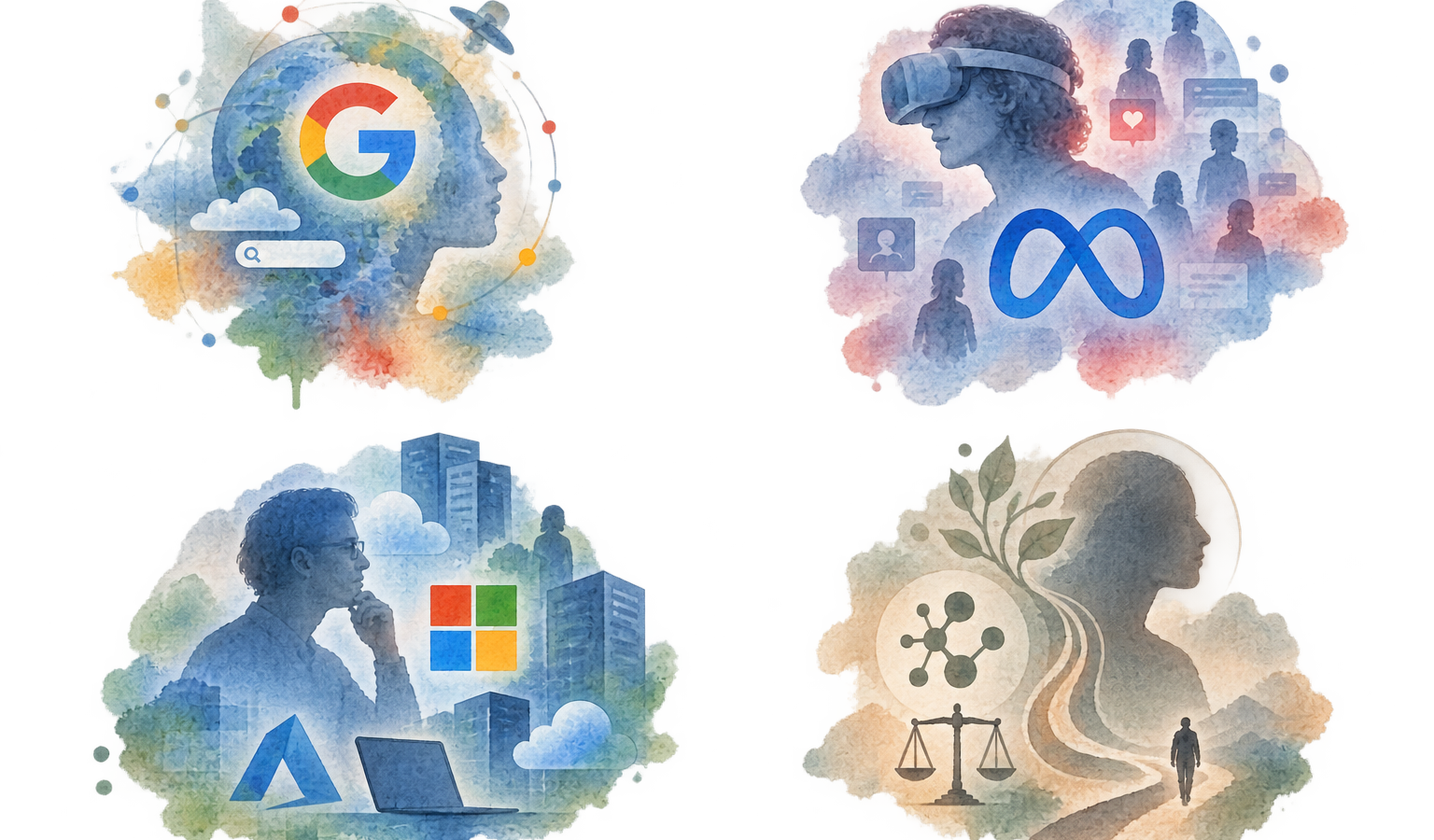
AI company philosophies rarely get compared side by side, but they should — because the four labs shaping the current AI race are building the same underlying technology on four incompatible bets about what it’s actually for.
Google calls it discovery. Meta called it — until very recently — a public good. Microsoft calls it infrastructure. Anthropic calls it a risk to be managed while it’s being built. These aren’t marketing differences. They show up in what each company releases, what it keeps locked behind an API, who gets to inspect it, and who gets blamed when it fails.
None of these philosophies is fixed forever. One of them broke in public this year — which turns out to be the most instructive part of the whole comparison.
Key Takeaways
- Comparing today’s leading AI company philosophies shows four incompatible answers to who each lab is actually building for.
- Google DeepMind frames its mission as “bold and responsible” — rapid deployment paired with an internal governance stack (AI Principles, Launch Review, an AGI Futures Council) that keeps risk review inside the same company setting the pace.
- Meta spent years building its identity around open-weight models and the argument that openness would out-compete closed labs — then partially reversed that position in 2026 under commercial pressure, showing how fast a stated philosophy can bend when a flagship model underperforms.
- Microsoft doesn’t bet on one model at all. Its philosophy is infrastructure neutrality — distributing OpenAI, Anthropic, and other models through Copilot and Azure, competing on enterprise governance rather than on having the best model.
- Anthropic ties its philosophy directly to deployment speed: a Responsible Scaling Policy that gives safety researchers formal authority to delay a launch, and a published constitution that states the model’s operating principles openly.
- Comparing the four side by side shows that “AI philosophy” isn’t really about technology — it’s about which stakeholder each company has structurally agreed to answer to.
Google DeepMind: Bold and Responsible, at Alphabet Scale
Google’s public framing of its own mission is that its approach to AI “must be both bold and responsible” — rapid deployment of AI in products used by billions, paired with safeguards for user safety, security, and privacy.
In practice, that pairing gets operationalized through layers most companies its size don’t build: a Launch Review forum that has to sign off on model releases, application-specific review panels for individual products, and — sitting above all of it — an AGI Futures Council that includes members of Google’s senior leadership and Alphabet’s board. Google’s own 2026 responsibility reporting frames the challenge explicitly as scaling responsibility alongside capability, particularly now that its systems act more autonomously through agentic tools rather than just answering questions.
The tension built into this model is structural rather than accidental. The body reviewing the risk and the body racing to ship the product sit inside the same corporate hierarchy, reporting up to the same leadership. Google frames this as integration — responsibility “embedded” into the full AI lifecycle rather than bolted on afterward. Critics of self-governance models generally frame the same arrangement as a conflict of interest: whoever funds the review ultimately funds the product it’s reviewing.
Google isn’t required to publish an outside audit of how often its internal review forums have delayed or blocked a launch, and it hasn’t. That’s not unusual in the industry — but it does mean the “bold and responsible” balance is something Google reports on itself, in a report Google itself writes.
Meta: The Open-Weight Gospel — and Its Retreat
For most of the last three years, Meta’s AI identity was inseparable from one argument: openness wins. Former chief AI scientist Yann LeCun made the case publicly and often, framing Meta’s release of Llama’s weights as a wager that open, inspectable models would out-innovate closed ones over time.
“The platform that will win will be the open one.”
That wasn’t just a technical bet. It doubled as a political one — Meta positioned itself as the counterweight to labs like OpenAI and Anthropic, which kept their most capable models behind an API. Hundreds of millions of Llama downloads gave Meta a credible claim to be the open alternative in a field increasingly defined by closed labs.
Then Llama 4 landed in April 2025 to widespread criticism over its coding and reasoning performance, and internal reporting later confirmed that some of its published benchmarks had been inflated using versions unavailable to the public. Meta spent roughly $14.3 billion for a stake in Scale AI and brought in its CEO, Alexandr Wang, as chief AI officer to rebuild the company’s AI effort. LeCun departed to start his own venture.
In April 2026, Meta released Muse Spark, its first model from the newly formed Meta Superintelligence Labs — and, for the first time in the Llama era, a closed, proprietary model whose code and weights are not public. Meta has said it hopes to open-source future versions. As of this writing, the flagship model competing most directly with OpenAI and Anthropic is not one of them.
A stated philosophy is not the same as a durable one. Meta’s shift from Llama to Muse Spark is the clearest evidence in the current AI landscape that “open by design” and “open by conviction” can be two very different commitments — and that the second one is the one that gets renegotiated when a model underperforms.
This isn’t a verdict on open-weight AI as an approach — plenty of Meta’s smaller models remain open, and the company says more openness is coming. It’s a case study in how quickly a company’s public identity can move when the commercial cost of holding the line gets high enough.
Microsoft: Betting on No One
Microsoft’s AI philosophy is the hardest of the four to summarize in a slogan, because it deliberately avoids picking a single model to be identified with.
Copilot launched running almost entirely on OpenAI’s models, backed by a Microsoft investment reported above $13 billion and an exclusive cloud arrangement through Azure. That looked, for a while, like total alignment with one lab’s approach. It wasn’t quite that simple even then — Microsoft has continued building its own smaller in-house models alongside the OpenAI partnership.
The clearer signal came later: Microsoft began offering Anthropic’s Claude models inside Copilot Studio and its Researcher agent, alongside OpenAI’s. The company’s own products team has described the underlying approach as choosing whichever model performs best for a specific task, routed through Azure AI Foundry’s multi-model catalog, rather than committing to a single vendor’s roadmap.
What Microsoft is actually selling, in other words, isn’t a model. It’s the governance layer around whichever model a customer chooses — tenant isolation, audit logging, data-loss prevention, role-based access control, all wrapped around Copilot regardless of which lab’s model answers the query. Microsoft’s Responsible AI Standard formalizes this as a set of enterprise commitments — fairness, accountability, transparency — that apply uniformly across models, rather than commitments tied to the behavior of any one system.
The philosophical bet here is that the frontier-model race is not where the durable value sits. Whoever wins the race between OpenAI, Anthropic, and Google, Microsoft’s position is to be the compliance and distribution layer enterprises route through either way — a bet on infrastructure over ideology.
Anthropic: Safety as the Business Model
Anthropic is the one lab among the four built by researchers who left another AI company specifically over disagreements about safety and deployment pace. That origin shows up structurally, not just in messaging.
Anthropic’s Responsible Scaling Policy assigns capability thresholds to models — for biological misuse, cyber-offense, autonomous action — and requires additional safeguards once a model crosses one. Crucially, the policy gives safety researchers the formal authority to pause or delay a launch if a threshold isn’t met, which is a governance structure, not just a stated value. Anthropic has said explicitly that it retains the right to pause development of its own systems in circumstances it judges to warrant it, independent of what the policy technically requires.
In January 2026, Anthropic published Claude’s full constitution — the explicit set of principles that shape the model’s behavior — under a public license, rather than treating it as internal or proprietary. The company also routinely publishes its own failure modes and misuse evaluations rather than only its benchmark wins, a practice most labs don’t volunteer.
Anthropic frames this posture as making its own safety commitments auditable rather than aspirational — governance instruments a customer or regulator could actually check, not just a values statement.
The trade-off is one Anthropic doesn’t hide: safety review that has real authority to slow a release is, definitionally, friction against speed — in a market where speed is often the entire competitive story. Whether that friction is a discipline worth the cost or a disadvantage against faster-moving competitors is exactly the kind of judgment call this piece isn’t in the business of making for you.
Comparing the Four AI Company Philosophies
Put side by side, these four AI company philosophies aren’t really disagreements about the technology. They’re different answers to who each company has structurally agreed to make itself accountable to.
- Google answers to its own multi-layered internal governance, sitting inside Alphabet’s leadership structure.
- Meta, until 2026, positioned openness itself — outside researchers, downstream developers — as the accountability mechanism; its retreat to a closed flagship model shows how conditional that commitment turns out to be under commercial pressure.
- Microsoft answers to enterprise customers and their compliance requirements, which is why it stays deliberately agnostic about whose model sits underneath.
- Anthropic answers to a safety framework with the formal power to override its own product timeline.
None of these are static positions. Meta’s pivot is the proof: a company’s AI philosophy is a claim about the present, not a permanent commitment — and the gap between what a company says it values and what it does under commercial pressure is usually where the real philosophy shows up.
What This Means for “Human-Centered AI”
This is where the comparison connects back to a question we’ve asked twice already on this site: who is a human-centered AI system actually built to serve? None of the four companies above build for “humans” in the abstract. They build for the constituency their governance structure is actually wired to answer to — a board, an enterprise customer, a developer community, a safety framework — and the differences between those constituencies are exactly the differences mapped out above.
The concentration of power question we raised in that piece — what practical control people retain when the infrastructure they depend on sits inside a small number of institutions — applies with extra force here, since three of these four companies control both the model and the primary distribution surface it reaches people through.
None of these AI company philosophies is correct and the others wrong. What comparing them does show is that “AI built for people” is never a neutral description. It’s always shorthand for “AI built for the people this particular governance structure was designed to protect” — and that structure is worth checking before taking the label at face value.
FAQ
Which AI company has the most “open” approach? Meta held that position for most of the last three years through its open-weight Llama models, and continues to release smaller open models. Its flagship model as of 2026, Muse Spark, is proprietary — making the label harder to apply to the company as a whole than it once was.
Does Microsoft build its own AI models? Microsoft develops some smaller in-house models but is best known for distributing other companies’ frontier models — OpenAI’s and, more recently, Anthropic’s — through Copilot and Azure AI Foundry, competing primarily on enterprise governance and integration rather than on having the top-performing model itself.
What makes Anthropic’s approach different from the other three? Anthropic is the only one of the four with a published policy that gives safety researchers formal authority to delay or pause a model launch, independent of product or business timelines, and it publishes its own failure modes alongside its capability claims.