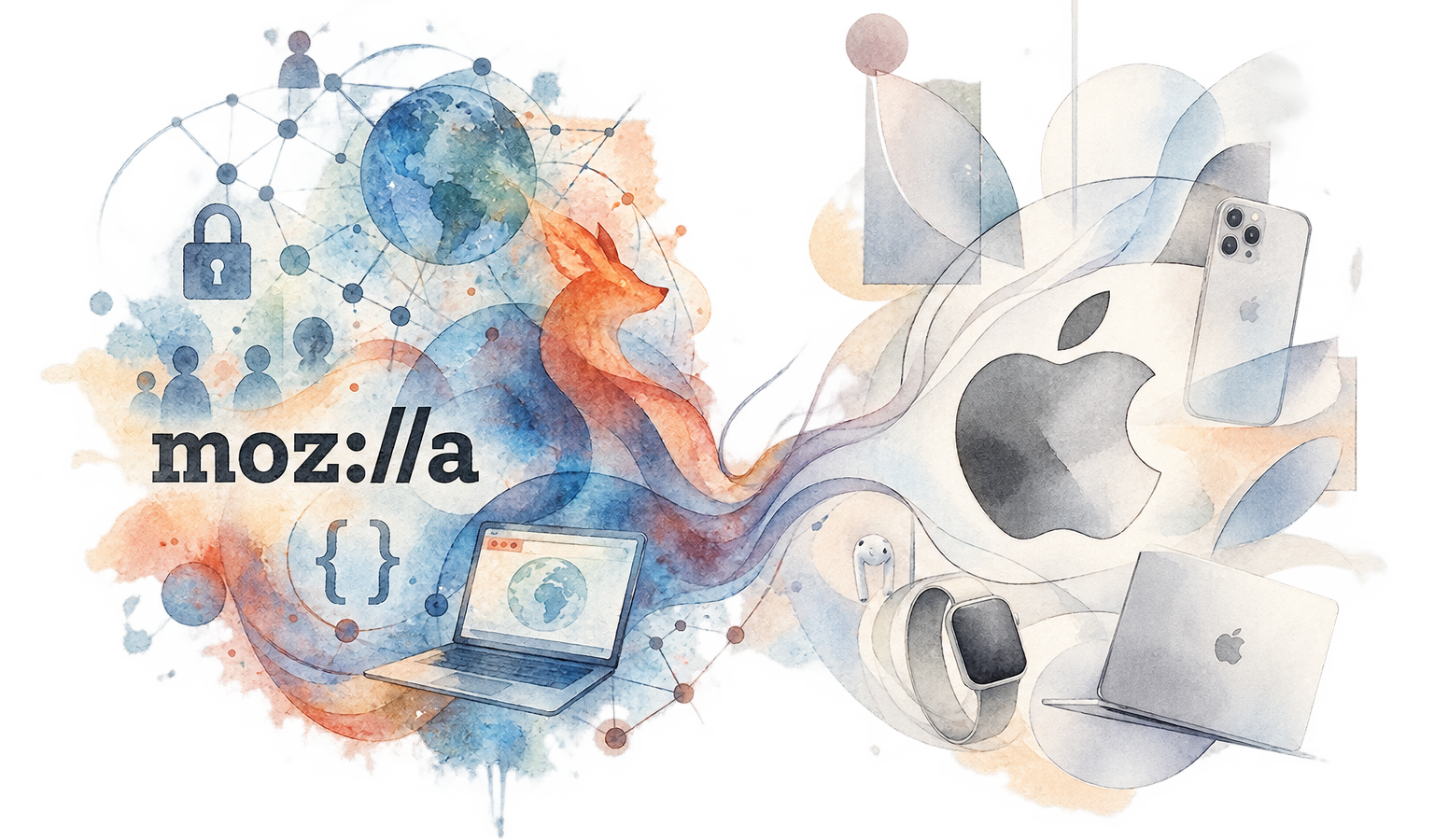
Mozilla vs Apple is not really a contest between two browsers, two brands or even two kinds of computer user. It is a comparison between two ideas about how technology should earn our trust. Mozilla begins with the belief that the internet is a public resource and that people must be able to shape it. Apple begins with the belief that technology becomes safer, calmer and more useful when one company takes responsibility for the whole experience.
Both ideas are attractive. Both have produced technology that millions of people genuinely value. Both also contain tensions that become easier to see once we stop comparing feature lists and start asking who has power, where that power comes from and what happens when the interests of users and institutions no longer align.
That is what makes this comparison interesting. Mozilla and Apple often use some of the same language—privacy, security, people, trust—while building very different relationships with their users. One asks us to trust an open process and the possibility of choice. The other asks us to trust a tightly managed system and the company responsible for it.
The difference reaches far beyond Firefox and Safari. It touches the broader philosophy of technology: whether freedom is best protected by giving people more control, or by designing a controlled environment that shields them from complexity and abuse.
Two Organizations That Begin With Values
Most technology companies publish a list of values. The interesting question is not whether the words sound good. They nearly always do. The interesting question is whether those values are visible in the structure of the organization, the way products are built and the trade-offs the organization is willing to accept.
Mozilla makes its philosophy unusually explicit. The Mozilla Manifesto describes the internet as a global public resource that should remain open and accessible. It says privacy and security are fundamental, that people should be able to shape their own online experiences, and that interoperability and decentralized participation are essential to the health of the internet.
Those are not merely promises about a product. They are claims about what the internet is and whom it should serve.
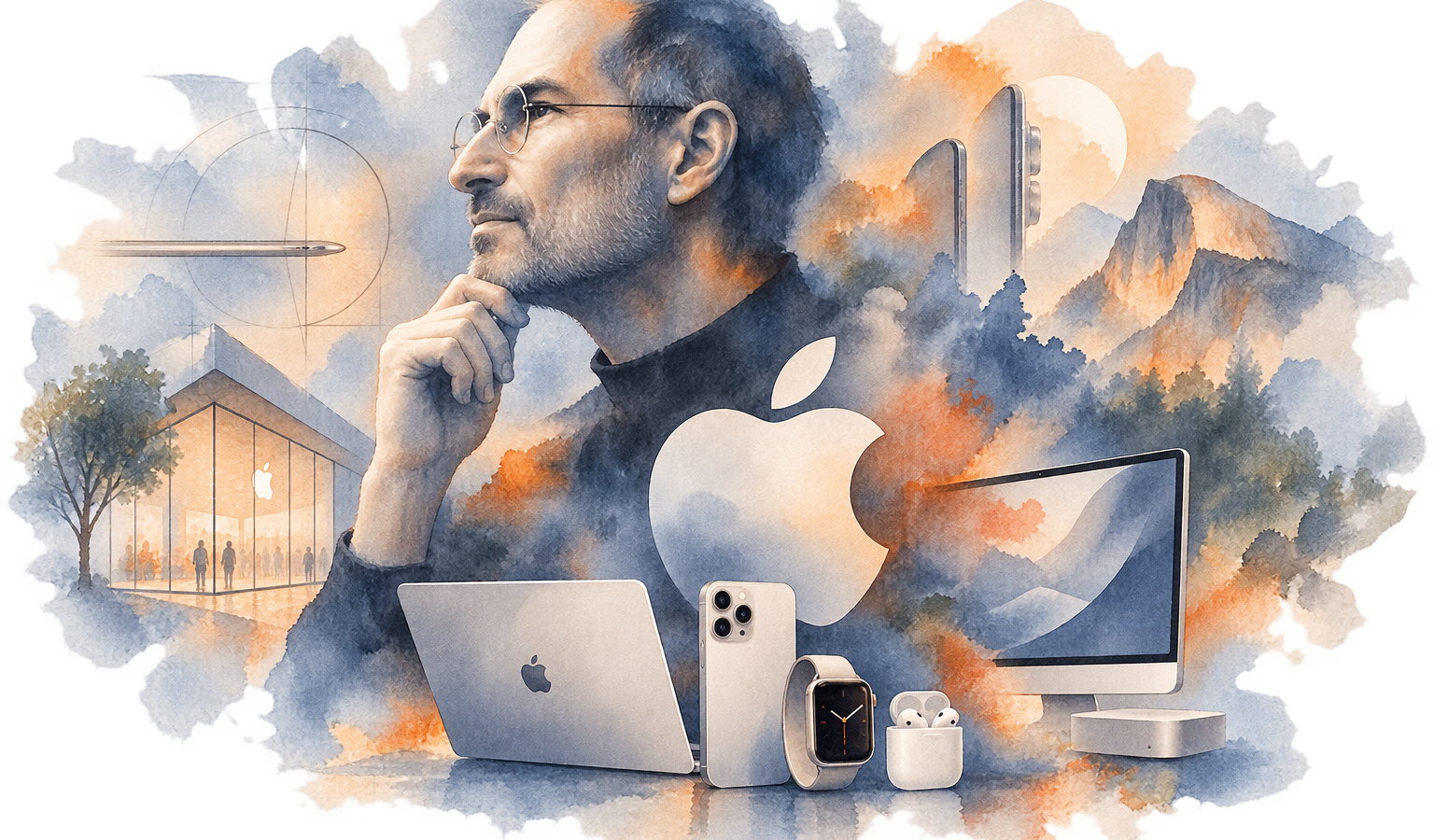
Apple also starts from values, but expresses them through products more than manifestos. Its public language emphasizes privacy as a fundamental human right, accessibility, environmental responsibility and the idea that technology should work for people. Yet Apple’s most recognizable philosophical commitment is found in the design of its ecosystem: hardware, software and services are developed together so that the user does not have to assemble the experience alone.
That difference matters. Mozilla’s philosophy begins at the level of the network. Apple’s begins at the level of the device and the person holding it. Mozilla asks what kind of internet society needs. Apple asks what kind of product experience a person should have.
Mozilla: The Internet as a Public Resource
Mozilla is easiest to understand if we stop thinking of it as simply the company behind Firefox. It is a project built around an argument: the web should not belong to any single corporation, platform or business model.
The phrase “public resource” is central. A public resource is not necessarily free of commercial activity. Roads carry delivery vans. Public squares contain shops. The web can support businesses, advertising, subscriptions and private communities without ceasing to have a public character. What matters is that participation is not entirely controlled by one gatekeeper and that common infrastructure remains usable across organizational boundaries.
This is why Mozilla places so much weight on open standards, interoperability and open-source software. If a website works according to shared standards, it can be visited from different devices and browsers. If the code of a browser engine can be studied, modified and debated, its behavior is not known only to the organization that owns it. If users can switch tools without losing access to the web itself, competition can happen at the level of products rather than at the level of permission.
Firefox is the practical expression of that philosophy. Its value is not limited to whether it wins every performance benchmark or offers the most polished tab animation. Firefox matters because it keeps an independently developed browser and engine present in the ecosystem. It represents the possibility that the web can be accessed through technology not controlled by the two largest mobile operating-system vendors or the largest online advertising company.
That does not make every Mozilla decision correct. A mission can guide an organization without making it immune to compromise, weak management or financial pressure. Mozilla still has to pay engineers, distribute products and compete for attention in a market where browsers are often preinstalled and treated as free. Ideals do not remove those constraints. They make the constraints more visible.
Apple: Technology as an Integrated Experience
Apple begins from almost the opposite intuition: fragmentation creates friction, and friction often harms ordinary users more than it empowers them.
For a technically confident person, choice can feel like freedom. For someone who simply wants a phone to protect their photos, receive updates and connect to headphones without an afternoon of troubleshooting, too many choices can feel like abandonment. Apple’s answer is integration. The company designs the chips, operating systems, devices, major services and distribution channels as parts of one experience.
This model gives Apple unusual control over details that other companies must negotiate with partners. Security features can be connected to hardware. Software updates can be designed for a known range of devices. Privacy permissions can be presented consistently across applications. Features can move between a phone, watch and laptop with relatively little configuration.
Apple documents this layered approach in its Platform Security guide, which covers hardware security, secure boot, encryption, app security and service protections. The point is not that Apple systems are invulnerable—they are not—but that the company can coordinate defenses across layers that are often separated elsewhere.
The price of that coordination is authority. Apple decides which technologies are supported, which applications enter its stores, which defaults appear on a new device and how far third parties may integrate with the platform. The company does not merely participate in the ecosystem. It designs the borders of that ecosystem.
But responsibility and power arrive together. The same control that helps Apple protect a platform also allows it to set commercial terms, restrict competing approaches and make leaving inconvenient. Integration can serve users; it can also create dependence. Usually, it does both at once.
Mozilla vs Apple: Two Approaches to Privacy
Privacy is where Mozilla vs Apple becomes more complicated than a simple open-versus-closed argument. Both organizations treat privacy as a defining value, and both can point to meaningful product decisions that support that claim. Yet they protect privacy through different theories of power.
Mozilla’s theory is that people need agency, transparency and alternatives. Privacy is weakened when a small number of companies can observe behavior across the web or dictate the tools through which people go online. Firefox therefore includes protections against common forms of cross-site tracking, while Mozilla also argues publicly for regulation, responsible data practices and a healthier internet.
This approach treats privacy as an ecosystem problem. A person cannot realistically protect themselves by reading every policy, changing dozens of settings and negotiating separately with every website. The architecture of the web and the incentives of major platforms must change too.
Apple’s theory is more architectural and product-centered. Its privacy overview emphasizes data minimization, on-device processing, permission controls and protections integrated into apps and operating systems. When possible, sensitive work should happen on the device rather than on a remote server. Apps should ask before accessing certain information. Hardware and software should cooperate to protect encryption keys and personal data.
This can be remarkably effective because Apple controls the system in which the protections operate. A privacy rule is not only a recommendation to an outside developer; it can become a platform requirement. A technical protection can be deployed through an operating-system update. A hardware feature can support a software guarantee.
Still, the two models ask for different kinds of trust. Mozilla asks users to trust open development, public principles and a plural web. Apple asks users to trust that a powerful company will use its control responsibly. Apple may collect less data for some purposes than advertising-driven competitors, but users remain dependent on Apple’s definitions, implementation and continuing policy choices.
Open code does not automatically create privacy, and closed code does not automatically destroy it. A badly designed open product can expose users. A carefully designed closed product can protect them. The deeper issue is accountability. Can outsiders inspect the claim? Can users choose another provider? Can a decision be challenged? What happens if the institution’s incentives change?
Privacy is strongest when good engineering and meaningful accountability reinforce each other. Mozilla tends to emphasize the second. Apple is particularly strong at the first. Neither can afford to ignore the other.
Openness Versus Controlled Integration
“Open” is one of the most overused words in technology. It can describe source code, standards, governance, access, compatibility or merely a marketing mood. That is why the distinction explored in free software vs open source matters: access to code is important, but it does not answer every question about freedom, power or purpose.
Mozilla’s openness is partly technical. Firefox is open-source software, its browser engine is developed in public and Mozilla supports the use of open web standards. But its openness is also strategic. The organization wants the web to remain a place where a developer can publish something without first receiving permission from a platform owner.
That feature of the web is so familiar that it can become invisible. A person can build a website, place it on a server and make it available to anyone with a standards-compatible browser. There may be hosting bills, laws and search algorithms to confront, but there is no universal app-store review standing between creator and visitor. The web’s openness does not eliminate gatekeepers, yet it makes total gatekeeping harder.
Apple’s model is built around controlled integration. This should not be confused with random restriction. Apple’s controls form a design philosophy: limit the number of variables, define interfaces carefully and accept responsibility for the result. The system becomes easier to secure and easier to explain because its boundaries are clearer.
The argument for this model is strongest when users face threats they cannot reasonably evaluate. Most people cannot audit an application’s code, judge a cryptographic design or understand every permission request. Platform review and secure defaults can protect people who have neither the time nor the expertise to protect themselves manually.
The argument against it appears when protection becomes permission. If the platform owner is the only party allowed to decide what software can do, safety rules may blend with commercial preferences. A restriction can protect privacy and preserve a business advantage at the same time. The motives need not be purely good or purely cynical for the conflict to exist.
This is the central tension in open vs closed ecosystems. Open systems distribute opportunity and risk. Closed systems concentrate coordination and power. We usually want the benefits of both: the freedom to leave, the safety to stay, the ability to experiment and the confidence that basic things will work.
Who Should Control the User Experience?
The phrase “user experience” sounds neutral, almost decorative. In reality, control over the user experience is control over choices, defaults and attention.
Mozilla generally treats the browser as an agent acting for the user. The ideal browser should help a person reach the web, manage privacy and customize the experience without turning the browser maker into the owner of everything beyond the window. This ideal is imperfectly realized, but it explains why browser choice and extension systems matter to Mozilla’s identity.
Apple treats the experience as a coherent product. Choices are curated so that the system remains understandable and reliable. Defaults are not gaps waiting for a user to fill; they are part of the design. From Apple’s perspective, asking every user to make every decision is not empowerment. It is poor product design.
Both positions contain truth. Defaults are necessary because nobody wants to configure every layer of a computer before using it. At the same time, defaults are powerful precisely because most people never change them. The organization choosing the default can direct traffic, shape behavior and determine which services gain an enormous structural advantage.
The fairest test is not whether a system has defaults or control. Every usable system has both. The test is whether those defaults serve a clear user interest, whether alternatives are genuinely available and whether switching is practical rather than theoretical.
Good technology respects different levels of involvement. It offers safe and sensible defaults to the person who wants things to work, while preserving real escape routes for the person who wants something different. Mozilla and Apple approach that balance from opposite directions. Mozilla begins with the escape routes. Apple begins with the defaults.
Business Models Shape Technological Values
No philosophy of technology is complete without a philosophy of money. Organizations can sincerely believe in values and still be shaped by the way they earn revenue.
Apple is one of the world’s largest commercial companies. It sells devices and services inside an ecosystem whose integration is part of the product’s appeal. Its current financial structure can be followed through Apple’s investor reports. The company benefits when users buy Apple hardware, remain within Apple services and continue to see the ecosystem as more valuable than a collection of separate products.
This business model can support privacy. Apple does not need to make targeted advertising the central purpose of every device interaction. It can sell premium hardware and market privacy as a reason to choose that hardware. That alignment is meaningful.
But the alignment is not permanent or complete. Apple also earns money from services, distribution arrangements and transactions made through parts of its ecosystem. It has incentives to retain users, protect platform control and favor experiences that strengthen the whole system. Privacy may be a core value, but it is also a competitive advantage.
Mozilla has a different structure and a different vulnerability. The Mozilla Foundation is a nonprofit organization, while Mozilla Corporation develops products such as Firefox. Mozilla publishes public records and financial informationbecause its mission depends partly on public credibility.
For years, a large share of Mozilla’s product revenue has been connected to search partnerships. That creates an uncomfortable tension: an organization working for a healthier, more competitive internet can depend financially on agreements with companies whose market power it may need to criticize.
The tension does not prove that Mozilla’s mission is false. It proves that alternative infrastructure is difficult to fund. Users expect browsers to be free. Building a modern browser engine requires sustained technical investment. Donations alone may not cover the scale of the work, while subscriptions and new products must compete in markets already crowded with powerful incumbents.
Mozilla therefore faces a philosophical problem disguised as a financial one: how can public-interest technology remain independent when the easiest available revenue comes from the institutions it exists to balance?
Apple faces the reverse problem: how can a company use integration to protect users without turning protection into an argument for unlimited control?
Firefox, Safari and the Future of the Open Web
Browser competition is often discussed as if browsers were interchangeable windows. They are not. A browser contains or relies on an engine that interprets web technologies, lays out pages, runs code and implements standards. The health of the web depends not only on the number of browser brands, but also on diversity among the underlying engines and the organizations influencing them.
Firefox uses Mozilla’s Gecko engine. Safari uses WebKit, closely connected to Apple’s platforms. Both support the common foundation of the web, and both participate in a standards ecosystem larger than either company. Organizations such as the World Wide Web Consortium provide forums and specifications through which web technologies can be developed across institutional boundaries.
Standards, however, do not implement themselves. A feature becomes part of the practical web only when browser engines support it and developers can rely on it. When too much usage concentrates around one engine or one corporate interest, websites may begin to target that implementation rather than the standard. What works in theory across browsers can slowly become “best experienced” in one environment.
This is why Firefox matters even to people who do not use it every day. An independent engine creates another center of technical judgment. It can challenge assumptions, expose compatibility problems and prevent one implementation from quietly becoming the definition of the web.
Safari matters for a different reason. It is deeply integrated with Apple devices and can bring privacy and energy-efficiency decisions to a vast user base. Apple’s position allows it to influence which web capabilities become widely available on its platforms. That can protect users from immature or intrusive technologies, but it can also slow capabilities that might compete with native applications or reduce platform control.
It would be too simple to portray Mozilla as always pushing progress and Apple as always blocking it. Browser features involve security, privacy, battery life, accessibility and long-term maintenance. Sometimes restraint is responsible. Sometimes it protects an incumbent position. Often both interpretations are plausible.
The important principle is plurality. The open web is healthier when no single company can determine its future alone. Independent engines, shared standards and genuine browser choice provide institutional checks, not just technical variety.
Can a Closed Ecosystem Still Protect Users?
Critics of closed systems sometimes speak as though control and user welfare can never coexist. That is difficult to defend. Apple’s ability to coordinate hardware and software has produced protections that would be harder to deploy in a fragmented environment. Secure boot, device encryption, biometric authentication, permission systems and long-term update mechanisms all benefit from integration.
Yet protective control requires limits because the guardian is also a market participant. Apple operates services that compete with third-party services, distributes applications and defines technical access to its platforms. Decisions made in the name of security can change the competitive landscape.
The solution is not to pretend that all restrictions are malicious or that all openness is safe. It is to demand proportionality and accountability. Is a restriction clearly connected to a documented risk? Is there a less controlling way to achieve the same protection? Can outside researchers evaluate the security claim? Can developers appeal decisions? Can users move their data and relationships elsewhere?
A closed ecosystem can protect users, but protection should not become a blank cheque. Trust deserves evidence, and power deserves boundaries.
Can an Open Organization Build Sustainable Products?
Mozilla’s challenge is equally serious. Openness does not guarantee relevance. A browser can be principled, technically capable and available to everyone, yet still struggle if people never encounter it, websites prioritize other engines and the organization cannot fund development.
Mozilla also has to make products people actively want. Mission cannot substitute for speed, polish, compatibility or clear communication. Users should not be asked to accept a frustrating experience as a donation to the open web. If Mozilla wants Firefox to embody its values, the browser has to make those values felt in everyday use.
That may mean privacy features that are understandable rather than merely present. It may mean tools that help people see and control what websites collect. It may mean services people are willing to pay for because they solve real problems without turning surveillance into the hidden price.
Sustainability also requires honesty about compromise. Mozilla will work with commercial partners. It will make decisions some contributors dislike. It may experiment, retreat and reorganize. The standard should not be ideological purity; no large technical institution can meet it. The standard should be whether compromises are transparent, limited and consistent with preserving the organization’s independence over time.
An open organization must do more than open its code. It must build durable governance, diversified funding and products strong enough to keep the mission present in people’s lives.
Mozilla vs Apple: Which Philosophy Better Serves Users?
The tempting ending to Mozilla vs Apple would choose a winner. That would miss the point. These organizations are best understood as answers to different failures in technology.
Mozilla is an answer to concentration. It reminds us that the internet should remain larger than the companies operating on it. Its philosophy is strongest when platforms become gatekeepers, when standards risk becoming private territory and when users need genuine alternatives.
Apple is an answer to fragmentation and exploitation. It reminds us that people need more than formal choice. They need products that are secure by default, understandable in practice and designed by an institution willing to take responsibility for the whole experience.
Mozilla’s danger is that principle without sufficient product power becomes symbolic. It may describe the internet we need while lacking the reach to defend it.
Apple’s danger is that excellent protection becomes a moral justification for expanding control. It may solve genuine problems while teaching users that the safest institution is one they can never meaningfully leave.
The better philosophy depends partly on the problem in front of us. If the problem is invasive tracking, both may offer useful protections. If the problem is dependence on a single platform, Mozilla’s commitment to openness becomes essential. If the problem is insecure defaults and confusing permissions, Apple’s integrated approach may serve ordinary users better. If the problem is who gets to define the future of computing, Apple’s concentration of power becomes harder to ignore.
Two Different Answers to the Same Question
Mozilla and Apple are asking the same underlying question: what must an institution do to deserve trust in a world shaped by software?
Mozilla answers that trust should be distributed. People need open infrastructure, public rules, transparent development and the ability to choose another path. No company, however competent, should become the permanent owner of the internet’s basic experience.
Apple answers that trust should be designed. People need a company to connect the layers, minimize exposure, set protective defaults and make difficult technical decisions on their behalf. A fragmented chain of responsibility can leave everyone in control of one piece and nobody responsible for the result.
We need both insights. Mozilla is right that power should remain contestable. Apple is right that responsibility must be concrete. Mozilla sees freedom in the ability to inspect, participate and leave. Apple sees freedom in being protected from complexity, tracking and unreliable systems.
That standard is demanding. Mozilla does not always reach it. Apple does not either. But comparing their philosophies helps us ask better questions of both.
When Mozilla speaks about openness, we should ask whether its products and finances can sustain genuine independence. When Apple speaks about privacy, we should ask whether privacy protections require all the control the company claims. When either organization asks for trust, we should look beyond the slogan and examine the architecture, governance and incentives underneath it.
Technology is never only what a product allows us to do. It is also the arrangement of power that decides what is allowed, who is protected and who can change the rules. Mozilla and Apple make that arrangement visible from opposite sides. One places its hope in an open internet that no one owns. The other places its confidence in an integrated ecosystem someone clearly controls.
The real task is not to turn either philosophy into dogma. It is to preserve the best of both: Mozilla’s insistence that the internet belongs to everyone, and Apple’s insistence that technology should take responsibility for the people who use it.