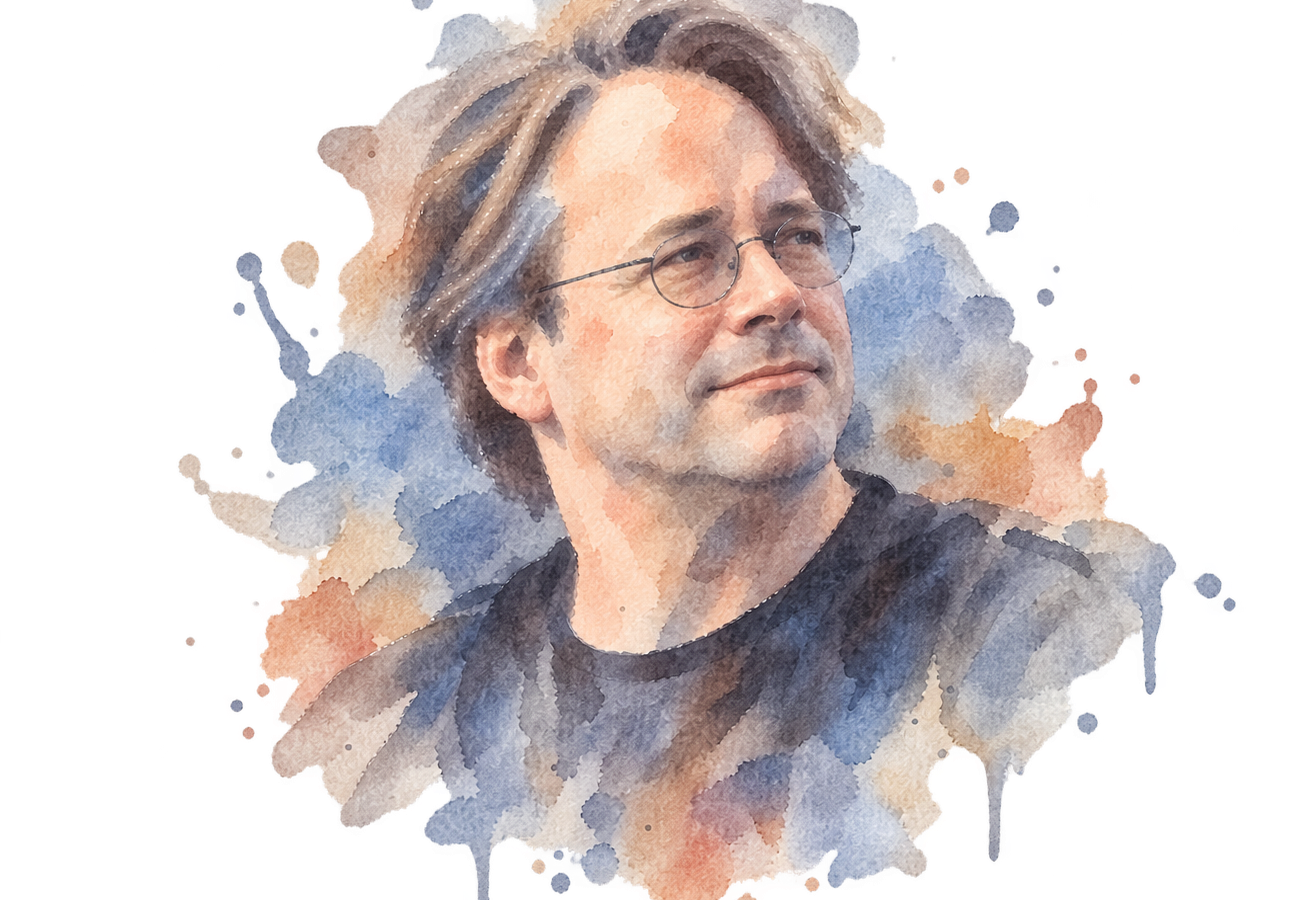
Linus Torvalds did not begin with a manifesto about how technology should reorganize society. He did not present Linux as the foundation of a new political movement, and he did not ask users to adopt a moral position before appreciating his work. He started with a technical problem, wrote a kernel and invited other people to help improve it. That modest beginning makes the eventual influence of Linus Torvalds and Linux even more remarkable. A personal project announced in 1991 became part of the foundation beneath servers, cloud platforms, Android phones, supercomputers, televisions, routers and countless devices that rarely mention Linux on the box.
The usual version of this story celebrates the triumph of open-source collaboration. It describes a global community building an operating-system kernel that eventually competed with some of the richest technology companies in the world. That account is broadly true, but it misses the more interesting part. Linux did not succeed simply because its source code could be inspected. It succeeded because Torvalds developed a philosophy of building software that was practical, selective and unusually comfortable with tension. The project could be open without being leaderless, collaborative without requiring consensus and idealistic in its results without demanding ideological agreement from everyone involved.
Linus Torvalds and Linux Began With a Practical Problem
When Torvalds began working on Linux, he was a computer science student interested in the capabilities of his own machine. The early project was not presented as a finished operating system or a grand attempt to transform the software industry. It was a kernel: the central layer that manages hardware resources and allows the rest of an operating system to function. That distinction matters because Linux is often used as though it were the name of an entire operating system. Strictly speaking, the Linux kernel is one crucial component, commonly combined with GNU tools, libraries, desktop environments and software maintained by many other projects.
The narrow technical starting point reveals something important about Torvalds. His influence grew from solving concrete problems rather than demanding agreement with a theory. People could participate because they wanted support for a particular processor, file system or device. A company could contribute because Linux was useful for its servers. An individual developer could fix a bug because it affected a machine sitting under a desk. Those motivations did not need to be morally pure or even particularly compatible. They only needed to produce work that could improve the kernel.
This was a different kind of unifying force. Instead of asking contributors to share one worldview, Linux offered them a shared object: functioning code. The project turned disagreement into engineering activity. Companies that competed in the market could cooperate on memory management, networking or hardware support because rebuilding those layers independently would waste time and money. Volunteers could work beside paid engineers without every contribution carrying a visible label explaining why it had been written. The kernel became common ground for people and institutions that might agree on little else.
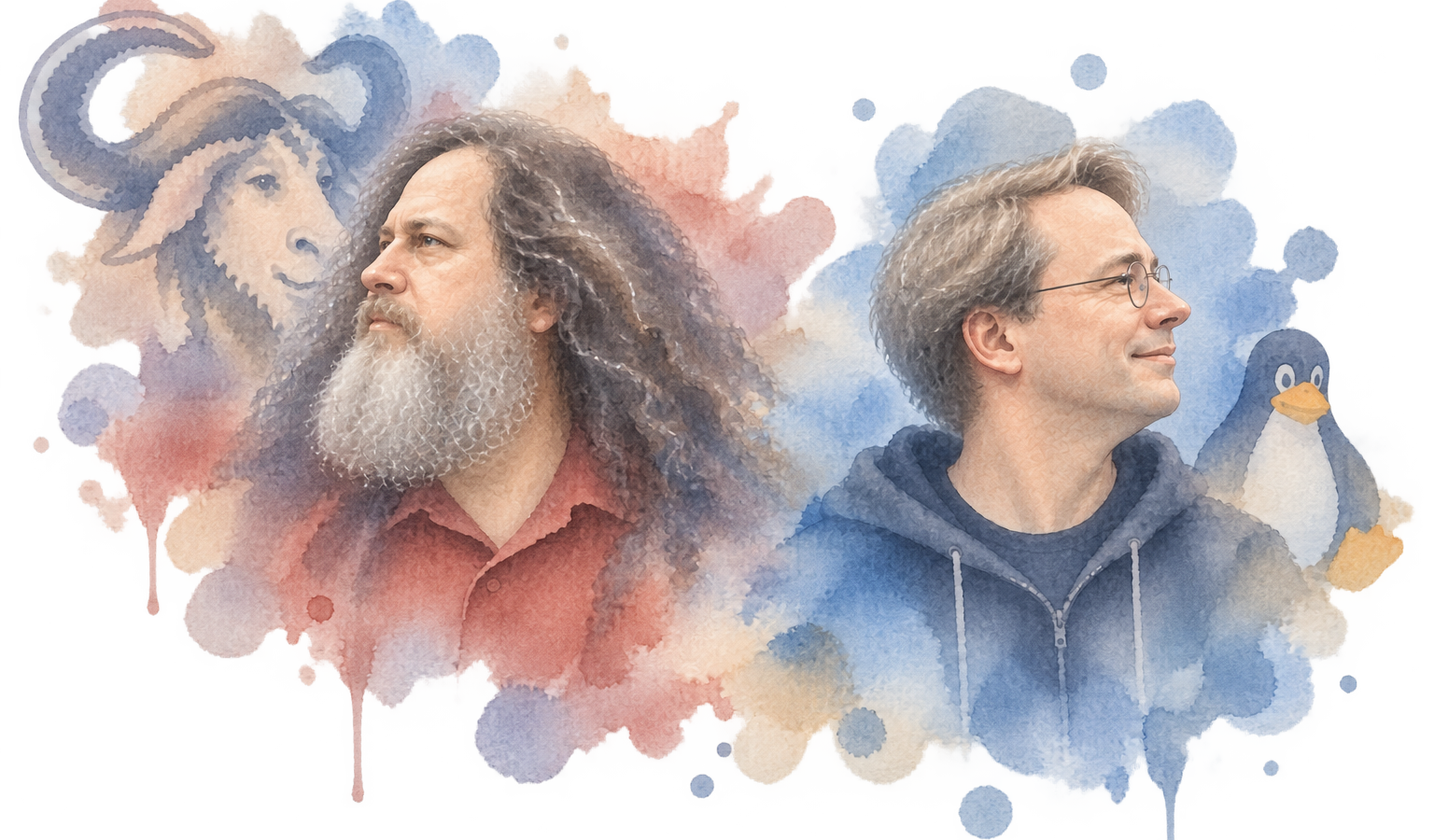
None of this means that values were absent. Choosing to develop Linux publicly, accepting contributions and later distributing the kernel under version 2 of the GNU General Public License had enormous consequences. The GPL required distributed modified versions to make corresponding source code available under the same license. It prevented the shared kernel from being quietly absorbed into a permanently proprietary fork. Torvalds did not treat that license in precisely the same moral language as Richard Stallman, but he recognized that it could protect the collaborative character of the project. Pragmatism, in this case, depended on a legal structure created by a much more ideological movement.
Pragmatism Is Not the Absence of Philosophy
Torvalds is often described as though he has no philosophy at all, only a preference for code that works. That description is convenient, but incomplete. Choosing practical outcomes over ideological consistency is itself a philosophy. It shapes what a project rewards, whose arguments carry weight and which compromises are considered acceptable. Torvalds has repeatedly treated open development as a powerful engineering method rather than a complete ethical system. The central question is less “Does this satisfy a universal theory of software freedom?” and more “Does this make the kernel better?”
That approach lowered the cultural cost of participation. A developer did not have to become an activist before submitting a patch. A hardware company did not have to abandon its business model before improving support for its products. Linux could accept contributions from people who believed in free software, people who preferred the language of open source and people who simply needed the kernel to perform well. The project grew because usefulness created its own gravity.
This pragmatism also gave Linux room to operate inside an imperfect industry. The kernel has long had to interact with proprietary firmware, undocumented hardware and companies that support openness selectively. A purist response might reject every compromise that fails to produce complete user freedom. Torvalds has generally been more willing to distinguish between improving the kernel and reforming the whole technology industry. That boundary allowed Linux to spread into environments that would never have accepted a complete political program.
The result was extraordinary technical reach, but the compromise came with a price. Linux could become ubiquitous without users becoming meaningfully aware of it. A person could own an Android phone powered by the Linux kernel while having little control over the operating system, the preinstalled applications or the cloud services connected to it. A company could build a closed platform on open infrastructure. Torvalds’s philosophy made adoption easier precisely because it did not require every layer above the kernel to follow the same principles.
The Kernel Is Open, but Its Governance Is Not a Democracy
Linux is frequently presented as a spontaneous community in which thousands of people collectively decide the future of the project. The reality is more structured. Development is distributed across many subsystems, each with experienced maintainers who review changes and decide which patches move forward. Those changes travel through a hierarchy before reaching the mainline kernel. Torvalds remains at the top of that technical structure, although the scale of Linux means that most decisions are made long before a patch reaches him.
This model is neither a conventional corporate hierarchy nor an egalitarian vote. Authority is strongly connected to technical responsibility, history and trust. Maintainers are expected to understand their areas, judge trade-offs and protect the stability of code used by systems around the world. The kernel’s own documentation describes both its development process and the responsibilities attached to maintainer roles. The system works because authority is divided, but not dissolved.
Torvalds’s great organizational insight was not that everyone should have equal influence over every decision. It was that a large project could remain open to contributions while preserving a clear path for judgment. Anyone can propose a change, but openness does not guarantee acceptance. Code must survive review, fit the project’s direction and avoid damaging existing systems. The barrier is not supposed to be permission to participate; it is the quality and suitability of the contribution.
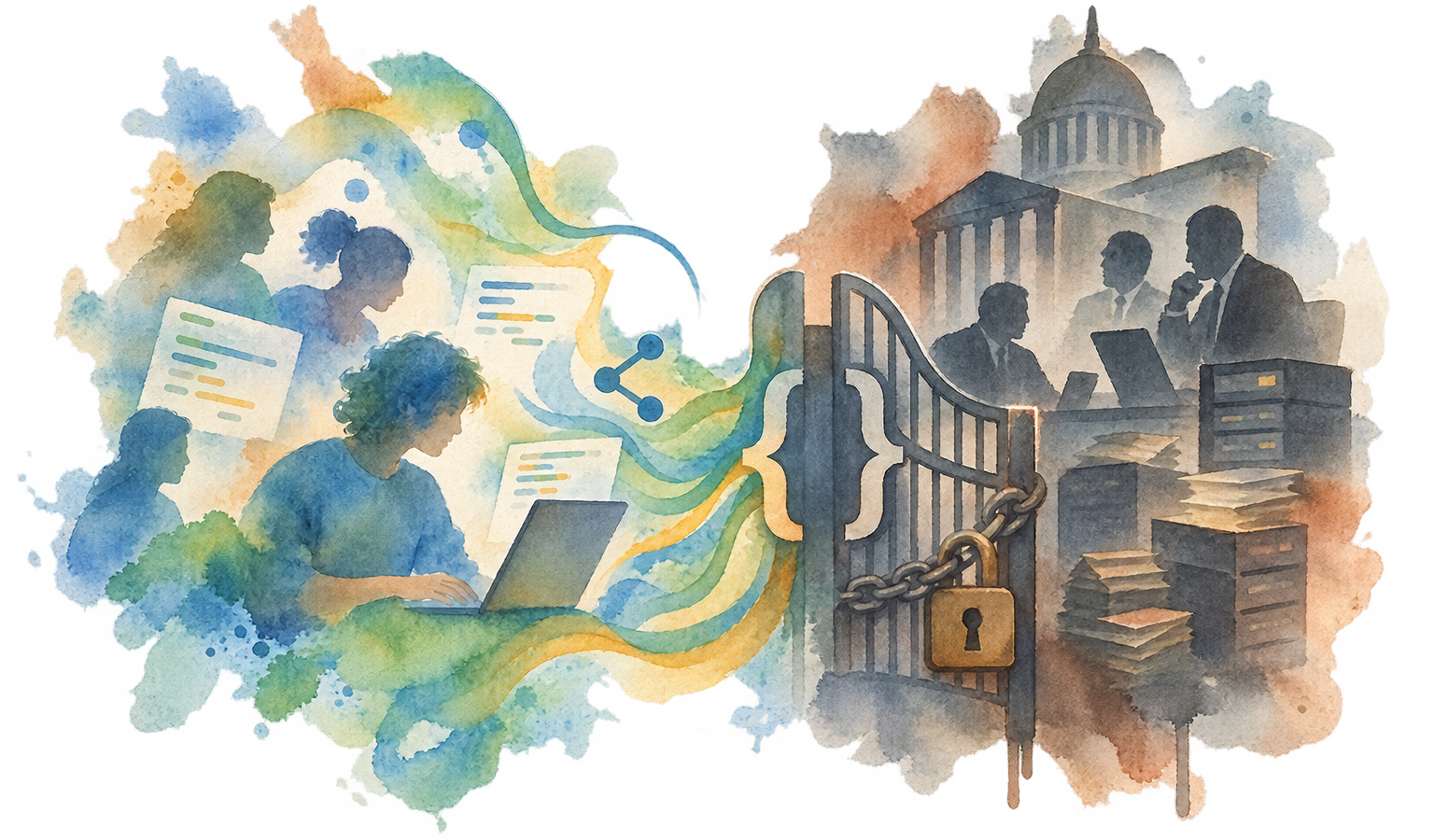
There is an obvious tension here. Linux demonstrates that open source does not necessarily mean open governance in the democratic sense. Users can inspect the code and developers can create forks, but the direction of the mainline kernel still depends on a network of people with unequal authority. That concentration is partly what keeps the project coherent. It is also a reminder that access to source code answers only one question about technological power. It does not fully explain who decides, who is heard or how leadership is held accountable.
This tension connects directly with the wider problem explored in Open Code, Closed Governance: Who Really Controls Open Source?. Linux is not an example of secretly closed development, but it shows why “the code is open” cannot be the end of the analysis. Governance is its own layer of technology, even when it is carried through mailing lists, trusted relationships and maintainership rather than boardrooms and shareholder votes.
Linux Turned Cooperation Into Infrastructure
The most important achievement of Linus Torvalds and Linux may not be any single technical feature. It is the creation of a durable place where cooperation became more valuable than duplication. The kernel sits low enough in the technology stack that many organizations benefit from improving it together. Hardware companies need reliable support. Cloud providers need performance and security. Device manufacturers need power management. Enterprise users need stability. None of them must surrender their entire commercial strategy to collaborate on the shared layer.
This arrangement changed expectations about how essential software could be built. In the proprietary model, infrastructure was often treated as a private advantage. A company developed its own operating system, protected the source and tried to keep customers inside the resulting ecosystem. Linux suggested another possibility: the common foundation could be developed in public while businesses competed through hardware, services, support, integration and applications.
The distinction is subtle but powerful. Sharing the foundation does not eliminate competition; it changes where competition happens. Companies no longer need to own every layer to build valuable products. They can invest in a common kernel because maintaining an isolated alternative would be expensive and strategically unnecessary. The same contribution that solves one company’s problem can improve the infrastructure used by everyone else.
This is not a charitable system. Corporate contributors participate because Linux serves their interests, and their resources inevitably influence what receives attention. Hardware enablement, virtualization, networking, security and data-centre performance matter because large organizations depend on them. Community needs and corporate needs often overlap, but not always. A project can be publicly developed while its priorities are shaped by institutions with the most engineers available to contribute.
Torvalds’s model does not remove power from software development. It makes power more visible in code, review and maintainership, while allowing different forms of power to coexist. A volunteer can still introduce an important improvement. A corporation can assign a team to a subsystem. A maintainer can reject work from either one. The process is open enough to observe, but technical participation remains easier for those with time, expertise and institutional support.
Linux Became the Invisible Foundation of Everyday Technology
For many users, Linux still evokes an alternative desktop operating system chosen by technically confident enthusiasts. That image is not false, but it describes only the most visible and least representative part of Linux’s influence. The kernel’s greater success happened where ordinary users rarely look: inside servers, network equipment, embedded devices and large computing systems.
When someone opens a website, streams media, stores a document online or asks a cloud service to process information, there is a strong chance that Linux exists somewhere in the chain. It may run on the physical server, inside a virtual machine, beneath a container or across an enormous cluster. The person using the service does not need to install Linux or even know its name. The kernel succeeds by becoming infrastructure—essential, widely shared and mostly invisible.
Android makes that invisibility easier to understand. Google’s official documentation states that the Android kernel is based on an upstream Linux long-term-supported kernel. Yet using Android does not feel like using a conventional Linux distribution. Google adds Android-specific changes, device manufacturers add their own layers and the user interacts with applications and services far above the kernel. Linux supplies a foundation, but it does not determine the philosophy of the complete product.
That distinction prevents two common exaggerations. Torvalds did not create Android, cloud computing or the modern internet. Those systems were made by vast numbers of people and organizations. At the same time, their development would look very different without the kernel he began and the community that formed around it. His influence is architectural rather than personal: he helped create a shared technical layer on which other people could build worlds he neither designed nor controlled.
The scale of this influence also complicates the meaning of technological success. Linux won in many places without replacing proprietary technology everywhere. It did not need every desktop user to choose it. It became indispensable underneath products that might remain closed at the interface, application and service layers. The revolution happened in the basement while the signs above the shops kept familiar corporate names.
Android Reveals the Limits of an Open Foundation
Android is one of the clearest examples of both the power and the limits of Torvalds’s pragmatic philosophy. Its Linux foundation gives manufacturers access to a mature kernel with broad hardware support, a large development community and a license that protects the openness of distributed kernel modifications. That shared base helped make Android adaptable across an enormous variety of devices.
But the freedom of the kernel does not automatically travel upward. Many Android devices include proprietary drivers, manufacturer interfaces, locked bootloaders and services tied closely to Google accounts and infrastructure. Applications can be closed, data collection can be extensive and software support may end according to a manufacturer’s commercial schedule. The presence of Linux does not guarantee that the owner of the phone controls the phone in every meaningful sense.
This does not make Linux irrelevant. It shows that technological freedom is layered. A free or open component can exist underneath a restricted user experience. Infrastructure may be inspectable while the service above it remains opaque. A platform can comply with the obligations of the kernel’s license and still organize the rest of the product around control, dependency and recurring data extraction.
That is where Torvalds’s pragmatism differs most sharply from the broader moral argument associated with Richard Stallman and free software. Stallman asks whether the user has essential freedoms across the software they depend on. Torvalds’s work proves that an open development model can produce extraordinary infrastructure even when participants do not agree about that ethical goal. The two ideas overlap, but their standards of success are not identical.
Linux succeeded technically inside Android. Whether Android succeeds as a system of user freedom is a separate question. The distinction is not an argument against Torvalds; it is a way to understand exactly what his model can and cannot accomplish. A kernel can provide an open foundation. It cannot, by itself, decide the values of every company that builds above it.
Git Extended Torvalds’s Philosophy Beyond Linux
If Torvalds had only created Linux, his place in the history of technology would already be secure. Git made his influence broader. In 2005, after the Linux kernel community could no longer rely on BitKeeper under the previous arrangement, Torvalds developed a new version-control system suited to the project’s unusual scale. The official history of Git identifies speed, simple design, distributed development, support for nonlinear work and the ability to handle a project as large as the kernel among its original goals.
Git carried the assumptions of Linux development into a general tool. Developers did not need one permanent central copy of a project to possess meaningful history. Each repository could contain the project’s record, branches could be created cheaply and work could move between people without requiring constant approval from a single server. Git was technical infrastructure designed around distributed participation.
Most developers now encounter Git through hosting platforms such as GitHub or GitLab, which can make it appear inseparable from a centralized online service. Yet Git itself is not GitHub. A repository can exist locally, move between hosts and be shared without one company owning the underlying version-control system. This separation is philosophically important. The tool is distributed even when the most popular interface built around it is centralized.
Here again, Torvalds’s influence contains a productive contradiction. Git made decentralized development normal, but convenience pulled much of that development back toward a small number of platforms. The protocol and repository remain portable, while issues, social relationships, automated workflows and project visibility may become attached to a particular service. Open infrastructure reduces dependence, but ecosystems can rebuild dependence above it.
Git also changed the culture of software work. It made branching, experimentation and parallel development easier at scales ranging from a student project to a global platform. The modern practice of submitting changes for review, tracking revisions and maintaining a visible technical history is not solely Torvalds’s invention, but Git helped standardize it. Millions of developers use an approach originally designed to manage the complexity of Linux, often without any direct connection to kernel development.
Torvalds Changed How Large Technical Communities Are Imagined
Before Linux, collaborative software development already existed. Free software projects, academic networks and internet standards had established rich traditions of sharing. Torvalds did not invent cooperation, public source code or distributed programming. His contribution was to prove that a loosely connected global community could build and continuously maintain a kernel capable of serving as industrial infrastructure.
That proof changed what companies were willing to trust. Open development no longer looked suitable only for tools maintained at the edges of commercial computing. Linux demonstrated that shared code could sit at the centre of critical systems. Its reliability did not emerge despite the number of contributors; the review process and diversity of use cases could become sources of strength, provided the project maintained technical discipline.
The phrase “community project” can make this sound gentler than it is. Kernel development has historically been demanding, argumentative and sometimes unnecessarily hostile. Torvalds’s blunt communication style became part of the project’s public identity, and criticism of that culture was not merely about politeness. A technical community can lose talented contributors when aggression is treated as proof of seriousness. In 2018, Torvalds stepped away temporarily and acknowledged the need to reconsider his behaviour, while the project adopted a Code of Conduct.
That episode matters to any honest account of his philosophy. Technical excellence does not excuse every form of leadership, and a system built around merit still depends on human judgments about whose work receives attention. The mythology of the brilliant, uncompromising programmer can hide the social labour required to keep a project healthy. Code may be the shared object, but people still write, review and maintain it.
Torvalds’s willingness to confront that problem, however imperfectly, also suggests that pragmatism can evolve. If a communication style harms participation and therefore harms the project, changing the culture is not a retreat from engineering values. It is an application of them. The health of the contributor community is part of the technical system, not an unrelated concern added by outsiders.
Open Source Won the Infrastructure and Lost the Interface
The modern technology industry often appears open when viewed from the server room and closed when viewed from the screen. Linux, open-source databases, programming languages and development frameworks power services that users can access only through controlled interfaces. The company may share important components while keeping its recommendation systems, operational data, moderation rules and business logic private.
This is perhaps the most revealing legacy of Linus Torvalds and Linux. The industry enthusiastically adopted the parts of openness that improved development, lowered infrastructure costs and encouraged shared maintenance. It was less eager to adopt forms of openness that would weaken control over customers or expose the systems that generate competitive advantage.
Torvalds’s philosophy was well suited to this world because it did not require complete ideological alignment. A cloud company can contribute to Linux while operating a closed service. A phone manufacturer can publish required kernel source while controlling the device’s interface. A platform can use Git internally while restricting the data and algorithms that define the user experience. Practical cooperation survives because it is limited to layers where interests overlap.
The question is whether this should be understood as compromise or realism. Without Torvalds’s flexible approach, Linux might have remained more ideologically consistent but far less influential. Because it welcomed contributors with mixed motives, it became infrastructure used across the world. However, ubiquity can create the appearance of a freer technological order even when users remain dependent on systems they cannot meaningfully examine or leave.
This is why Free Software vs Open Source remains more than a debate over terminology. Open source asks whether access to code produces better development. Free software asks what freedoms users should possess. Linux offers powerful evidence for the first proposition. The platforms built on top of Linux show why the second question did not disappear.
The Limits of Pragmatism
Pragmatism is powerful because it accepts the world as it is and looks for changes that work within it. It can bring volunteers and corporations into the same project, turn ideological rivals into technical collaborators and make open infrastructure useful in places where a purer movement might be rejected. Linux is one of the strongest arguments ever made for that approach.
Pragmatism can also become too satisfied with technical success. If the kernel performs well, the development model scales and companies continue contributing, deeper questions may appear external to the project. Does the device respect its owner? Can the user leave the service without losing years of data and social connections? Are decisions made transparently? Does open infrastructure merely make a closed platform cheaper to operate?
Those questions cannot all be answered at the kernel level, and it would be unfair to assign them personally to Torvalds. Still, the world built on Linux invites them. Technical openness is real and valuable, but it is not the same as user autonomy. A system can contain millions of lines of open code while presenting the user with one non-negotiable button: accept.
The danger is not Torvalds’s pragmatism itself. The danger is allowing the industry to define pragmatic openness as the final form of technological freedom. Open development can improve security, reliability and innovation while leaving power over services, data and interfaces highly concentrated. Linux shows what collaboration can achieve. The platforms above it show what collaboration alone does not solve.
Linus Torvalds Built More Than a Kernel
Linus Torvalds did not offer the technology industry a complete moral theory. He offered something it could use: a kernel, a development process and later a version-control system designed for large-scale distributed work. That practical orientation made his influence unusually difficult to contain. Linux entered servers, phones, embedded devices, cloud infrastructure and supercomputers because it solved real problems for people who did not need to agree about everything else.
His philosophy is best understood not as an absence of principles, but as a belief that good systems emerge from open work, strong technical judgment, distributed contribution and continuous correction. It trusts working code more than declarations, but it also relies on licenses, institutions and human relationships that code cannot replace. Its success came from combining openness with hierarchy, community with corporate participation and flexibility with a stable shared foundation.
The digital world Torvalds helped build is more open at its foundations than the proprietary computing industry of the early 1990s might have suggested. It is also more centralized at the level where most people experience it. That contradiction does not diminish Linux. It explains why Linux matters so much. The kernel became common infrastructure precisely because it could serve systems with radically different values.
Richard Stallman gave software freedom a moral language. Linus Torvalds gave collaborative development a form capable of becoming global infrastructure. The distinction should not reduce either figure to a slogan. It should help us see why modern technology contains both legacies: code that can be shared, systems that can be improved by strangers and platforms that remain firmly controlled from above.
Torvalds’s achievement is therefore larger than making Linux popular. He demonstrated that openness could operate at the centre of modern computing rather than at its margins. He proved that a project did not need one corporate owner to become dependable, ambitious and essential. Yet the world that adopted his methods also learned how to place closed experiences on top of open foundations.
Linux changed who could build the infrastructure of technology. The unfinished question is who controls everything built above it.