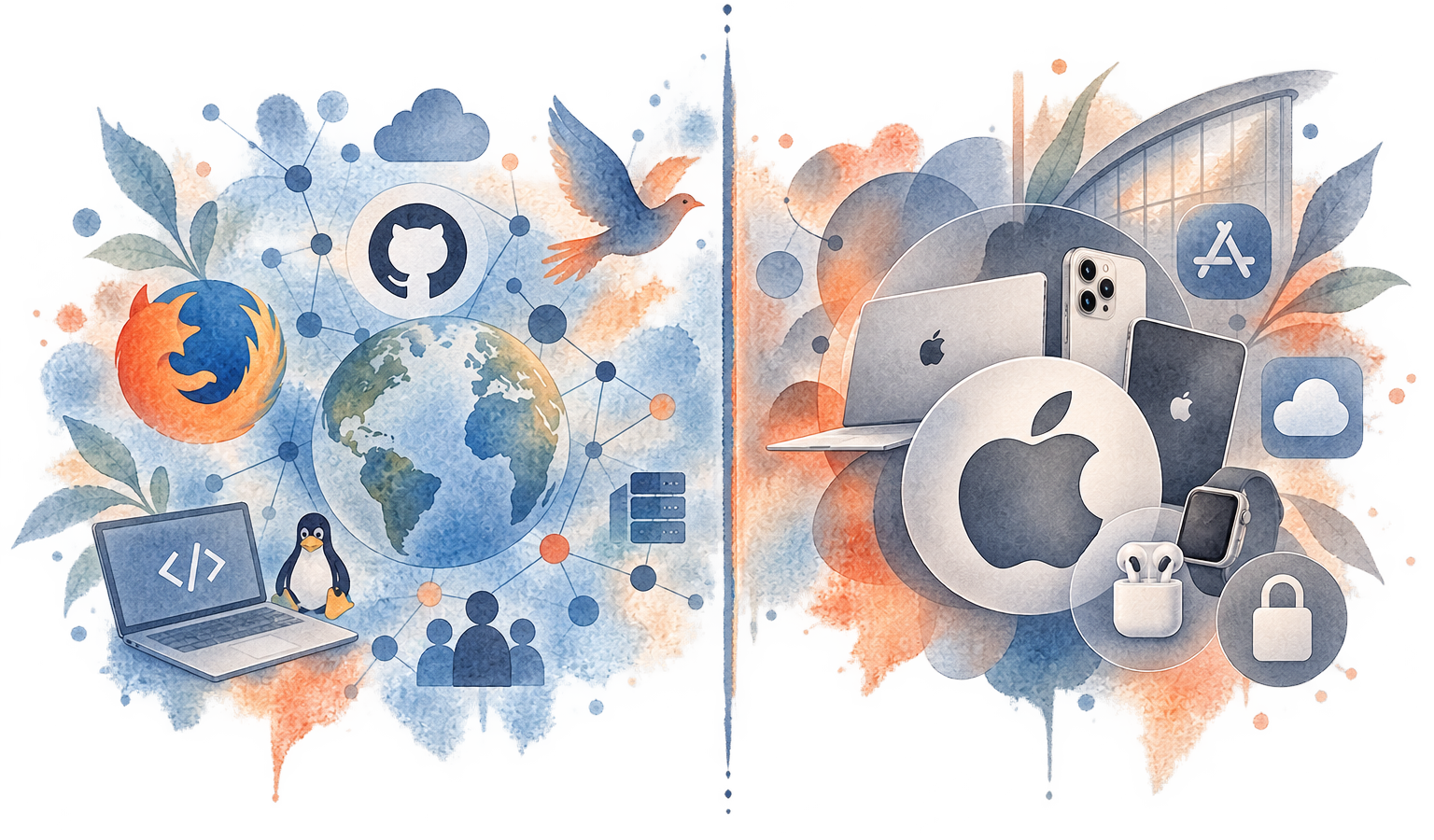
Open vs closed ecosystems are usually compared through a list of products. One side has more devices, another offers more customization, and a third promises that everything will work together without asking the user to understand how. That comparison is useful when buying a phone or choosing a platform, but it misses the deeper question.
An ecosystem is not simply a collection of compatible products. It is a structure of permissions, dependencies, and relationships. It determines who can participate, which connections are encouraged, how easily data can move, and what happens when a user wants to leave.
The most successful ecosystems rarely feel restrictive at first. They feel convenient. A new device recognizes an existing account. Photographs, passwords, messages, and settings appear automatically. Accessories connect with little effort. Applications share familiar conventions. Problems can often be solved by contacting one company instead of tracing responsibility across several vendors.
These are real advantages. Convenience is not evidence that someone has been deceived, and a tightly integrated system is not automatically hostile to its users. In many cases, coordination can improve reliability, accessibility, privacy, and security.
The philosophical issue appears later, once convenience becomes dependence. A system that makes entry effortless may make departure expensive. A product that works beautifully with its relatives may behave poorly with everything outside the family. The same integration that removes complexity can also concentrate control.
This is why the open vs closed ecosystems debate cannot be reduced to a contest between good and bad companies. Both models solve problems, and both create new ones. The important difference is how they distribute power between platform owners, developers, manufacturers, and users.
As with the broader philosophy of technology, the useful question is not only what an ecosystem allows people to do. It is who gets to decide the conditions under which they can do it.
Every Ecosystem Makes a Promise
An ecosystem begins with a promise: choose this environment and separate pieces of technology will behave like parts of one coherent system.
That promise addresses a genuine frustration. Modern technology is assembled from many layers—hardware, operating systems, applications, accounts, cloud services, accessories, payment systems, identity tools, and communication networks. When those layers are designed by unrelated organizations, compatibility can become the user’s problem.
Open and closed ecosystems offer different answers.
A closed ecosystem promises coordination. One organization, or a small group of approved partners, defines the important rules. It can test specific combinations, create consistent interfaces, and make decisions without waiting for agreement across an entire industry.
An open ecosystem promises participation and choice. Different organizations can build compatible products, implement shared standards, and replace parts of the system without asking one platform owner for permission.
Neither promise is perfectly fulfilled. Closed systems still rely on outside developers, suppliers, networks, and standards. Open systems still need governance, technical specifications, certification, and people capable of resolving disagreement. “Open” never means the absence of rules, while “closed” rarely means total isolation.
The labels describe tendencies rather than two pure categories. A platform can open one layer and close another. It may publish source code while controlling the most valuable services. It may support common file formats but restrict application distribution. It may allow third-party accessories while reserving its best integrations for first-party products.
Understanding an ecosystem therefore requires looking beyond the marketing label. The real structure is found in APIs, licenses, standards, default settings, export tools, approval processes, and the practical cost of choosing an alternative.
What Is an Open Technology Ecosystem?
An open technology ecosystem allows multiple participants to build, connect, and compete through rules that are not controlled exclusively for the benefit of one vendor. It may be based on open standards, open source software, public documentation, accessible interfaces, portable data formats, or some combination of them.
The web is the most familiar example. Websites do not need to be created by one company, and people do not need a particular brand of computer to visit them. Different browsers can implement shared technologies such as HTML, CSS, and JavaScript. The World Wide Web Consortium develops web standards with interoperability, accessibility, privacy, security, and international use in mind.
That openness does not make every website, browser, or online service open source. Open standards and open source software are related but distinct. A proprietary application can implement an open standard, while an open source application can still connect to a service controlled by a single organization.
The difference matters. Open source concerns access to and legal rights over code, as explained in free software vs open source. Open standards concern the agreements that allow independently developed products to communicate.
An open ecosystem works best when users can replace one component without rebuilding everything. They might change a browser while keeping access to the same websites, move an email account while continuing to communicate through a common protocol, or open a document in software made by another company.
This freedom is never absolute. Standards can be incomplete, implemented differently, or influenced by dominant companies. Data may be technically exportable but difficult to use elsewhere. A product can claim compatibility while offering a noticeably worse experience outside its preferred environment.
Still, openness creates the possibility of pluralism. It gives smaller developers and manufacturers a path to participation that does not depend entirely on negotiating private access with the owner of a platform.
What Is a Closed Technology Ecosystem?
A closed technology ecosystem places more of the system under unified control. The platform owner may design the hardware, operating system, application marketplace, cloud services, accessories, and account infrastructure, or it may decide which partners can access particular features.
This model is often described as a walled garden. The phrase captures the trade-off well. A garden can be carefully maintained, secure, coherent, and pleasant. The wall can keep some dangers out. It can also determine who may enter, which plants are allowed to grow, and how easily a visitor can leave with anything collected inside.
Closed ecosystems can coordinate development across layers that would otherwise be fragmented. Apple, for example, explains its security model as a combination of hardware, software, applications, and services designed to work together. Its Platform Security guide presents integration as a way to protect information without making security incomprehensible to the user.
That benefit is not imaginary. When a company controls both the hardware and operating system, it can build security features into specialized components, coordinate software updates, and enforce consistent rules across supported devices.
Control also gives the platform owner the ability to favor its own products, restrict competing services, set commercial terms, and decide which forms of customization are acceptable. A user may receive a more predictable experience while losing the ability to change parts of the system independently.
A closed ecosystem does not need to block every outside product. Many depend on large communities of third-party developers and accessory makers. What makes the structure closed is that important forms of participation remain conditional. Access exists because the platform owner permits it, and the conditions can change.
Why Closed Ecosystems Often Feel Better
People do not choose closed ecosystems only because they lack technical knowledge or have been persuaded by advertising. They often choose them because the experience is genuinely better for their needs.
Consistency reduces mental effort. A person who learns how one device handles settings, permissions, sharing, and accessibility can carry that knowledge to another. Interfaces feel familiar. Support staff understand the expected configuration. Developers can optimize for a smaller range of known hardware.
Integration can also remove repetitive setup. A pair of headphones can move between devices. A photograph taken on a phone can appear on a computer. A password created in one application can be available in another. These features are possible in open systems, but a company controlling several layers can implement them more quickly and present them as one experience.
Security is another advantage. A curated application store can reduce exposure to obvious malware. Hardware-backed security can protect encryption keys. A coordinated update process can deliver fixes across supported devices without depending on several manufacturers and network operators.
There is also value in accountability. When hardware, software, and services come from one company, the user knows whom to blame when something fails. In a more open environment, every vendor may claim that another component caused the problem.
These advantages explain why “more open” is not always synonymous with “more usable.” A system can provide theoretical freedom while transferring every integration problem to the individual. Most people do not want technology to become a permanent maintenance project.
The strongest criticism of closed ecosystems should therefore acknowledge what they accomplish. If an argument for openness cannot explain how ordinary users will receive comparable reliability, safety, and convenience, it remains incomplete.
The Hidden Cost of Seamless Integration
The price of integration is often paid gradually.
At first, each additional product makes the ecosystem more useful. A phone works better with a particular computer. The computer works better with a particular cloud service. The cloud service becomes the easiest place to store years of photographs, documents, notes, and messages. Accessories add another layer of compatibility.
No single purchase creates complete dependence. The effect accumulates.
Eventually, leaving no longer means replacing one product. It means changing workflows, moving data, learning new interfaces, repurchasing applications, losing exclusive features, and sometimes persuading other people to move as well. A family messaging group or shared photo library can create stronger lock-in than any technical restriction.
Economists call this a switching cost. The term sounds neutral, but the design of that cost matters. Some switching costs are unavoidable. Moving to a different operating system will always require adjustment. Others are deliberately preserved because they discourage competition.
The difference can be found in details. Can photographs be exported with their original metadata? Can purchased media work outside the original application? Can passwords move to another manager? Can a smartwatch retain useful functions with a different phone? Can conversations continue across competing messaging services?
A platform does not need to prohibit departure if it can make departure exhausting. Consent becomes weaker when a person remains not because the service is still preferred, but because years of accumulated dependence make alternatives unrealistic.
This is where convenience changes character. A feature designed to save time today can become a mechanism that limits choice tomorrow. The feature itself may remain useful; the problem is the absence of a practical exit.
Interoperability Is a Form of User Freedom
Interoperability is the ability of different products and services to exchange information and work together. It sounds like a technical concern, but it has direct consequences for individual freedom.
If two systems can communicate, users can choose between them without losing contact with everyone who chose differently. If data uses a documented format, another application can read it. If an accessory follows a common protocol, changing phone brands does not necessarily turn it into electronic waste.
This is one reason open standards matter. They reduce the amount of permission required to build a compatible product. A developer can implement the shared specification rather than negotiate a unique private agreement with every platform owner.
Interoperability also changes competition. A new service does not need to recreate an entire network before offering a better feature. It can compete at one layer while remaining connected to the larger environment.
The European Union’s Digital Markets Act interoperability rules reflect the political importance of this issue. Certain designated platforms must provide third parties access to operating-system hardware and software features available to the platform owner’s own services or hardware. The aim is not to make every system identical, but to prevent control of a platform from becoming an automatic advantage in every market built above it.
Interoperability still requires limits. Opening an interface carelessly can weaken security or expose personal data. Different services may not share the same privacy standards. A platform must be able to protect the integrity of its system.
The presence of risk does not end the debate. It makes the design of access more important. “Security” should not become a universal explanation for excluding competitors, just as “openness” should not become an excuse to ignore genuine threats.
Good interoperability allows connection without requiring a platform to abandon proportionate protections. The difficult question is who decides what counts as proportionate.
Open vs Closed Ecosystems: Security and Privacy
Security is frequently used as the strongest argument for control. A smaller number of approved components can be tested more consistently. Centralized rules can prevent unsafe behavior, and rapid updates can address vulnerabilities before fragmented participants respond.
Closed integration can therefore create real security benefits. Apple’s model shows how hardware and software developed together can support features that are difficult to reproduce through loosely connected components. A controlled application-distribution system can also screen software before it reaches users.
But centralized control creates its own concentration of risk. A vulnerability, mistaken policy, or compromised account can affect many connected services at once. Users may also be unable to install an independent solution when the platform owner declines to approve it.
Open ecosystems distribute responsibility more widely. Publicly accessible code and documented standards allow independent experts to examine systems and build alternatives. Multiple implementations can prevent one failure from affecting everyone in the same way.
Openness does not automatically produce security. Public code can contain vulnerabilities for years without anyone fixing them. Fragmented devices may stop receiving updates. Users may install untrustworthy software because the system gives them greater freedom to do so.
Privacy follows a similar pattern. A closed ecosystem funded primarily through hardware or subscriptions may have less incentive to track behavior for advertising. Centralized integration can enable more processing to happen on a device rather than sending information among unrelated services.
At the same time, the platform owner may gain visibility across many areas of a person’s digital life. Users must trust its technical architecture, policies, and future decisions. If data cannot move easily, privacy concerns may not be enough to make leaving practical.
The correct conclusion is not that open systems are secure and closed systems are not, or the reverse. Security and privacy depend on architecture, incentives, maintenance, defaults, transparency, and accountability. The label describes the distribution of control, not the quality of every decision made within it.
Open Platforms Can Still Concentrate Power
Android illustrates why open and closed are not simple opposites. The core Android platform is an open source, Linux-based software stack, as described in Google’s Android platform documentation. Manufacturers can adapt the Android Open Source Project for different devices and form factors.
Yet the Android experience familiar to most consumers also depends on proprietary Google applications and services, manufacturer customizations, application stores, certification requirements, and commercial agreements. An open foundation can support layers that remain tightly controlled.
The same pattern appears elsewhere. A company may publish the code for a platform while controlling the official brand, hosted service, user accounts, extension marketplace, or channels through which most people obtain it. Forking remains legally possible, but building a viable alternative may require far more than copying a repository.
Network effects are especially powerful. A messaging application becomes more valuable when friends and family already use it. A marketplace attracts sellers because buyers are present, while buyers arrive because it has sellers. A social platform can publish substantial code without making its community portable.
This is why evaluating open vs closed ecosystems requires more than checking a license. Source code freedom matters, but so do governance, data portability, interoperability, distribution, trademarks, infrastructure, and the ability to reach other users.
An ecosystem can be open at the technical layer and closed at the social or commercial layer. It can also use proprietary code while supporting open formats and strong interoperability.
The most useful analysis identifies which layer is open, which is closed, and who benefits from that arrangement. A single label cannot do that work for us.
Can an Ecosystem Be Both Open and Controlled?
Every functioning ecosystem combines openness with control. The real disagreement concerns where the boundary should sit.
Even the open web depends on standards, browser security rules, domain registration, hosting providers, moderation decisions, and organizations capable of maintaining shared infrastructure. Complete openness without governance can produce incompatibility, abuse, and systems that ordinary people cannot trust.
Closed platforms also depend on openness. They use internet protocols, web standards, open source components, common media formats, and third-party applications. A company may control the device experience while relying on a larger technical commons it did not create alone.
Hybrid models can work well. A platform might protect sensitive security components while publishing documentation for safe third-party access. It might curate a default application store while allowing informed users to install software through other channels. It might offer tightly integrated cloud services while supporting complete export through common formats.
The quality of the model depends on whether control is connected to a legitimate purpose and whether it remains proportionate. Restrictions that protect encryption keys are different from restrictions that merely prevent a competing accessory from receiving the same capabilities as a first-party product.
Transparency helps distinguish the two. Platform owners should explain what is restricted, why the restriction exists, and what evidence supports it. Independent review becomes particularly important when the organization making the rule also profits from limiting competition.
Openness also needs responsibility. Developers requesting access to sensitive systems should meet clear security and privacy requirements. Interoperability cannot mean that users surrender protection whenever two services connect.
The goal is not a world without gates. It is a world in which gates exist for understandable reasons, use fair rules, and do not quietly become permanent walls around every part of digital life.
Five Questions for Evaluating Any Ecosystem
Theoretical labels become more useful when converted into practical questions.
1. Can important data leave in a usable form?
An export tool should provide more than a large archive of files that no alternative service can understand. Photographs should retain useful metadata. Contacts should use a standard format. Documents should open in other applications without losing their essential structure.
Portability does not require every competitor to reproduce every feature. It requires enough continuity that leaving remains a credible option.
2. Can third parties access the same important capabilities?
A platform may advertise a large developer community while reserving its best hardware or software integrations for its own products. Compare what outside developers are technically allowed to build with what the platform owner can build for itself.
Equal access may need security conditions, but those conditions should be clear and available to comparable participants.
3. What stops working when one component is replaced?
Changing a phone, computer, cloud provider, browser, or accessory should reveal the architecture of the ecosystem. If replacing one component causes unrelated purchases and services to lose essential functions, integration has become a source of dependence.
Some loss is inevitable. The question is whether incompatibility follows from a genuine technical limitation or a strategic decision.
4. Who can change the rules?
Read beyond current features. Can one company alter prices, technical access, moderation rules, application requirements, or support periods without meaningful participation from users and developers?
Centralized governance can act quickly, which is valuable during security incidents. It can also transform an entire ecosystem through a decision made behind closed doors.
5. Does convenience remain valuable after dependence is established?
The best ecosystem continues earning loyalty after users have invested in it. It does not need to make alternatives artificially painful.
Ask whether people remain because the experience is still better or because years of purchases, data, habits, and relationships have made change unrealistic. The answer may be a mixture of both, but recognizing the mixture matters.
These questions do not generate a universal winner. They help identify the type of control a particular ecosystem asks users to accept in exchange for its benefits.
Open vs Closed Ecosystems: Which Model Serves Users Better?
The answer depends on what users need, but it should not depend entirely on what they understand at the moment of purchase.
A person may reasonably prefer a closed ecosystem because it offers reliable updates, accessible support, strong integration, and privacy features that work without constant configuration. Another may prefer an open environment because it allows customization, independent repair, competing stores, alternative services, and greater control over software.
Neither choice proves that one person values freedom while the other does not. Freedom also includes the ability to choose simplicity. The problem begins when simplicity can be obtained only by surrendering future choice, or when openness is offered without the maintenance and usability needed to make it practical.
The best ecosystems borrow strengths from both models. They provide coherent defaults without making those defaults permanent. They protect security while documenting fair routes for third-party participation. They make services easy to join and data realistic to move. They compete through quality rather than accumulated exit costs.
This balance is difficult because platform owners benefit from dependence. A company that controls the operating system, marketplace, payment system, identity layer, and cloud service gains advantages that extend far beyond improving the user experience.
Competition law and regulation have entered the discussion because individual choice cannot correct every structural imbalance. A user cannot personally negotiate interoperability with a global platform. Developers cannot compete fairly when access to essential capabilities depends on the discretion of a direct competitor.
Still, regulation cannot design every interface or predict every security risk. Technical standards, responsible platform governance, independent scrutiny, and informed users all remain necessary.
The open vs closed ecosystems question is therefore not settled by choosing one permanent model. It is answered repeatedly through decisions about access, defaults, portability, security, and power.
Convenience Should Be Chosen, Not Enforced
An ecosystem is at its best when it makes technology feel smaller than the life surrounding it. Devices cooperate, data remains available, and ordinary tasks do not require constant technical attention. Good integration gives people time back.
That achievement deserves recognition. Criticism of closed systems becomes shallow when it treats every convenience as manipulation. Openness becomes shallow when it asks users to accept unnecessary difficulty as proof of independence.
But convenience should remain a benefit that people continue to choose, not a dependency they become unable to escape. A system confident in its quality should be able to offer export, interoperability, repair, and fair third-party access without assuming that every open door will cause users to leave.
Open ecosystems need an equally demanding standard. Permission without usability is not enough. If alternatives are confusing, insecure, poorly supported, or dependent on unpaid labor, formal freedom may have little value in everyday life.
The future of technology will not be completely open or completely closed. It will be built from layers: some shared, some proprietary, some regulated, and some controlled by communities. The central question is whether those layers preserve meaningful agency for the people who depend on them.
When evaluating an ecosystem, the polished moment of entry tells only part of the story. Look at the exits. Look at the interfaces offered to competitors. Look at what can be repaired, exported, replaced, and understood. Look at which restrictions protect users and which protect the platform from competition.
The difference between open and closed is ultimately a difference in who must ask permission.
A well-designed ecosystem may coordinate many parts of digital life. It should not quietly claim ownership over the life being coordinated.