The philosophy of technology begins with a simple suspicion: the tools around us are doing more than helping us complete tasks. They are quietly shaping the tasks we consider worth doing, the choices we notice, the habits we develop, and the limits we learn to accept.
A smartphone is not merely a smaller computer. A social network is not simply a digital meeting place. A search engine does more than retrieve information, and a cloud service does more than store files. Each of these systems presents a particular version of the world. It decides what should be easy, what should be difficult, what should remain visible, and what should happen somewhere beyond the user’s view.
Most of the time, this influence feels ordinary. A button is placed where a thumb naturally lands. A notification appears at the moment we are most likely to respond. A subscription renews automatically. A device works beautifully with products from the same company but becomes awkward when asked to cooperate with anything else. None of these decisions looks philosophical. Together, however, they reveal a philosophy.
Technology is often discussed through specifications: speed, battery life, processing power, camera quality, storage, model size, or the number of features included in the latest update. Those details matter, but they tell us what a product can do, not what kind of relationship it creates between its maker and its user.
That second question is the territory of the philosophy of technology. It asks us to look behind the polished surface and consider the values built into the products that increasingly organize everyday life. Who has control? What does the user truly own? Which freedoms are protected? What is collected, and why? What must be surrendered in exchange for convenience?
These questions do not require a rejection of technology. They require something more useful: learning to see technology clearly.
What Is the Philosophy of Technology?
The philosophy of technology examines what technology is, how it changes human life, and which moral, political, and social assumptions shape its development. It does not begin and end with the question of whether a particular invention is good or bad. Its deeper concern is how technologies reorganize the relationship between people, institutions, companies, and the world around them.
This field has a long history, but it has become unusually relevant in the digital age. Earlier tools often remained visibly separate from the person using them. A hammer could be placed on a shelf. A machine could be switched off at the end of a shift. Digital systems are different. They accompany us through work, entertainment, communication, shopping, travel, education, and intimate parts of daily routine. Many continue collecting, processing, recommending, and updating even when we are not actively thinking about them.
The Stanford Encyclopedia of Philosophy describes technological design as a goal-oriented process. Technical objects are created with functions and affordances: they make certain actions possible, encourage some uses, and make other actions difficult or impossible. This connection between design, goals, and human behavior is one reason it is difficult to claim that technology is entirely neutral.
Consider a messaging service that encrypts conversations by default. Its design treats private communication as something worth protecting without requiring special expertise from the user. Now consider a service where privacy controls are hidden inside several menus and the default settings favor extensive data collection. Both products may offer privacy options, but they do not express the same priorities.
The difference is philosophical before it is technical. One design assumes protection should be built in. The other places responsibility on the individual, often knowing that most people will never change the default.
The philosophy of technology therefore asks a better question than “What does this product do?” It asks, “What view of the user, society, and power made this product seem like the right thing to build?”
Technology Is Never Just a Neutral Tool
There is a familiar argument that technology is neutral and that only its use can be good or bad. According to this view, a platform, algorithm, or device is simply an instrument. Responsibility belongs entirely to the person holding it.
The argument sounds reasonable because people clearly use the same tool in different ways. A smartphone can help someone learn a language, document an injustice, waste an afternoon, or stay in touch with family. The device does not mechanically determine one outcome.
But neutrality is not the same as flexibility. A technology may support several uses while still making some behaviors easier, more attractive, or more profitable than others. Design creates a landscape of possibilities, and that landscape is never flat.
A road does not force anyone to drive to a particular destination, but its route determines which places are connected and which are bypassed. In the same way, a digital interface does not dictate every action, yet it directs attention through defaults, rankings, permissions, and friction. The bright button invites. The hidden setting discourages. The endless feed removes a natural stopping point. The absence of an export option makes departure costly.
Even the decision to include or exclude a feature expresses a judgment. If a device cannot be repaired without proprietary tools, the design privileges controlled service over independent repair. If a platform provides no chronological feed, it places algorithmic selection between users and the people they chose to follow. If software requires a permanent account for a function that could technically work offline, the company has decided that identification serves its goals.
This does not mean every constraint is malicious. Products need boundaries. Security sometimes requires restrictions. Simplicity depends on removing options, and a coherent experience is impossible if every decision is handed to the user. The important point is that these trade-offs exist. Calling technology neutral can hide them from examination.
Once a system reaches millions or billions of people, small design decisions become social forces. A default can shape behavior at a scale that laws and public campaigns struggle to match. That is why interface design, software architecture, and business models deserve philosophical attention. They are not decorations placed on top of technology. They are where its values become practical.
Freedom: Who Is Allowed to Control the Software?
Digital freedom is easy to misunderstand because software often feels intangible. If an application is installed on a device we own, it seems natural to assume that it belongs to us in a meaningful sense. Usually, however, we receive limited permission to use code that remains controlled by someone else.
That arrangement is not automatically unfair. Developers deserve to decide how their work is distributed, and companies need sustainable ways to fund products. The philosophical problem appears when users become dependent on systems they cannot inspect, modify, preserve, or leave without losing important parts of their digital lives.
The free software movement offers one of the clearest alternatives. The GNU Project defines free software through four essential freedoms: the ability to run a program for any purpose, study and modify how it works, share copies, and distribute modified versions. In this context, “free” refers to liberty rather than price. Paid software can respect these freedoms, while software available at no financial cost can still deny them.
These principles matter beyond programmers. Access to source code can sound irrelevant to someone who never intends to read it, but individual rights often remain valuable even when they are exercised through others. Most people do not personally test their drinking water, audit financial institutions, or inspect the structure of a building. They benefit because qualified people are allowed to do so.
Open code can permit independent experts to investigate behavior, communities to maintain abandoned projects, and organizations to adapt tools without waiting for a single vendor. It changes the balance of power even for users who never touch a line of code.
Proprietary software can still be excellent, ethical, secure, and respectful. Open source can be poorly maintained, confusing, or governed by a small group with little accountability. A license alone does not settle every moral question. It does, however, determine which forms of participation and independence are legally possible.
The central issue is agency. Can people continue using a useful tool if its original creator changes direction? Can they move their work elsewhere? Can a community repair software after commercial interest disappears? A system that offers no meaningful answer asks users to trust not only the product as it exists today, but every future decision of the organization controlling it.
Privacy: Who Controls the Data?
Privacy is often presented as a setting. Turn this option off, refuse that permission, delete a history, or open a private window. These controls are useful, but they can create the impression that privacy is mainly a matter of personal discipline.
In reality, privacy begins much earlier, during the design of a product. Before a user sees a consent screen, someone has already decided which data the system wants, whether processing happens on the device or on a server, how long information is retained, and which parts of the business depend on observing behavior.
This is why privacy policies alone cannot tell us whether a product respects privacy. A policy explains practices—sometimes clearly, sometimes not—but architecture determines which practices are necessary in the first place. A service cannot accidentally expose data it never collected. A company cannot build a detailed profile from information it chose not to retain.
Apple’s published privacy framework, for example, emphasizes data minimization, on-device processing, transparency and control, and security. Mozilla’s manifesto describes security and privacy on the internet as fundamental rather than optional. These statements do not place either organization beyond criticism. They are valuable because they make the claimed philosophy visible, giving the public a standard against which products and decisions can be judged.
Privacy also involves more than secrecy. People may have nothing dramatic to hide and still deserve spaces where they are not continuously measured. Private thought, tentative exploration, and ordinary mistakes are part of human development. When every click becomes an input, behavior can change simply because observation is expected.
The usual trade-off between privacy and convenience is also less fixed than it appears. Some services genuinely need information to function. A navigation application cannot calculate a route without knowing a location. But it does not follow that every piece of location history must be stored indefinitely, connected to an advertising profile, or made available for unrelated purposes.
The better question is not whether data is used. It is whether the amount collected is proportionate, whether the purpose is understandable, whether the user has meaningful control, and whether the product could have been designed to need less.
Privacy is therefore not an extra feature for cautious users. It is a design philosophy about restraint. It asks a company to recognize that technical ability is not the same thing as moral permission.
Digital Ownership: What Do We Actually Own?
Ownership used to feel relatively straightforward. Buy a book and it remained on the shelf. Buy a record and it could be played without asking the publisher for permission again. Buy a tool and its manufacturer could not remotely remove a function after the sale.
Digital products have blurred this relationship. We buy devices that rely on remote servers, media that arrives through revocable licenses, and software whose continued operation depends on accounts, subscriptions, activation systems, or decisions made in another country. The payment may look like a purchase while the underlying relationship resembles temporary access.
This distinction becomes visible when a service closes, a title disappears from a library, a smart device loses server support, or an account is suspended. The physical object may remain in the user’s hands while some of its essential abilities vanish. What appeared to be ownership was partly a continuing service arrangement.
There are legitimate reasons for connected products. Cloud services enable synchronization, collaboration, backups, and features that would be difficult to provide locally. Subscriptions can fund ongoing development and security updates. The problem is not that every product must work forever without outside support. The problem is that the limits of ownership are rarely made as emotionally clear as the promise of purchase.
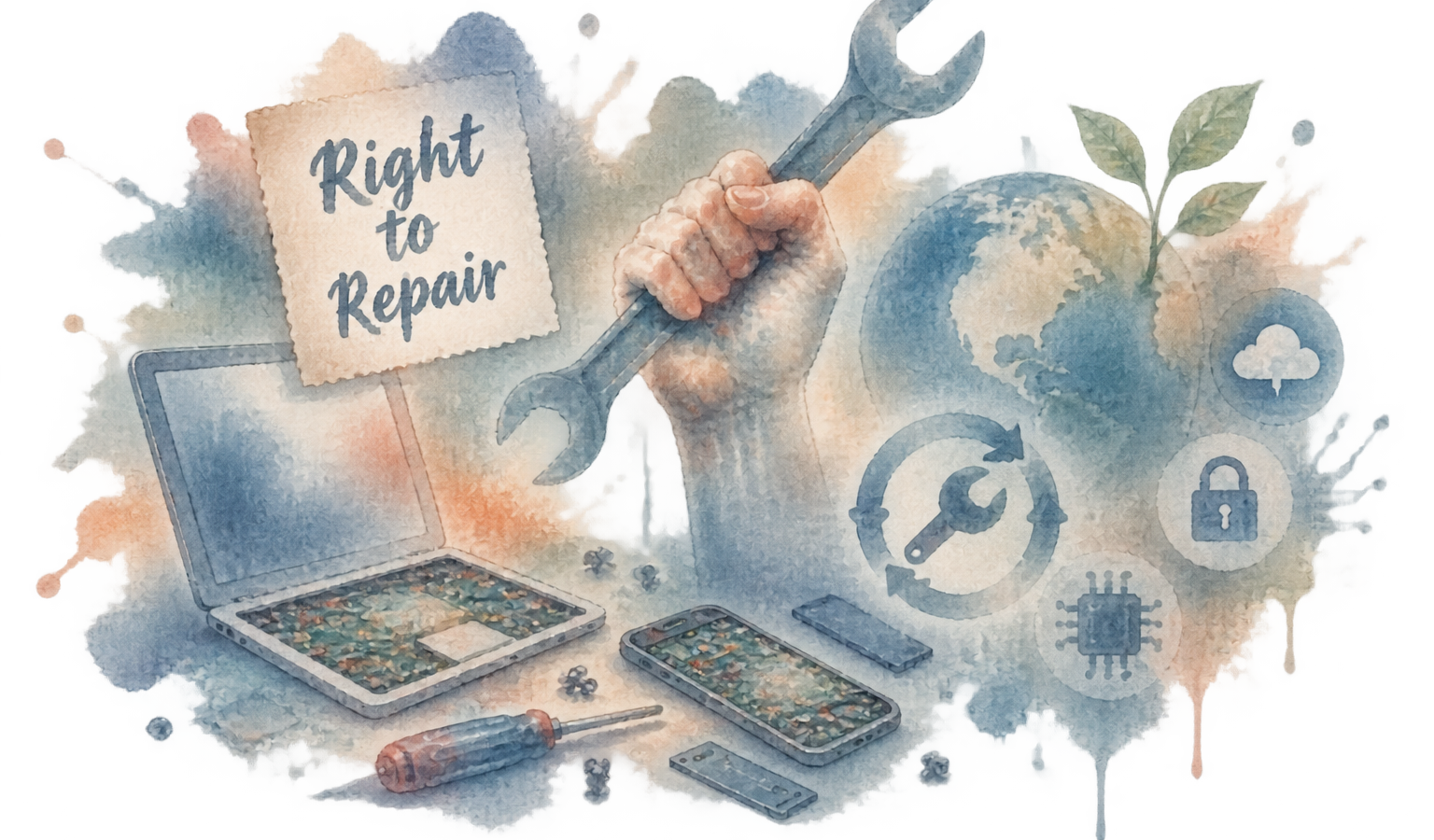
Repair reveals the same tension in hardware. If parts, diagnostic tools, manuals, or software pairing remain exclusively controlled by a manufacturer, legal ownership does not necessarily produce practical control. The owner can possess the object while lacking the ability to maintain it independently.
This is why the right to repair has become more than a consumer complaint. It is a debate about what ownership should mean in an era when software controls physical objects. European rules encouraging more durable and repairable products show that design decisions once treated as private company choices can become matters of public policy.
Digital ownership should not require absolute control over every component. Connected systems are complicated, intellectual property matters, and security must be protected. Still, ownership becomes thin when a user cannot repair, transfer, preserve, or meaningfully understand the conditions attached to a product.
A useful test is simple: after paying, which important powers remain with the seller? The longer that list becomes, the more carefully we should use the word “own.”
Convenience and the Hidden Price of Closed Ecosystems
Closed ecosystems are attractive for good reasons. Products designed by the same company often work together with less setup. Files appear where expected. Accessories connect quickly. Interfaces share a visual language. Support is easier when responsibility is not divided among several vendors.
This coherence can be a genuine benefit, not a trick. People should not be shamed for choosing tools that save time or reduce frustration. Convenience is a real human value.
Yet convenience can gradually become dependence. The more purchases, data, habits, and relationships accumulate inside one ecosystem, the more expensive leaving becomes. The price is not limited to buying replacement hardware. It may include moving years of photographs, losing purchased media, rebuilding workflows, persuading family members to change messaging services, or accepting that certain accessories will no longer work.
This is known as switching cost, but the phrase sounds cleaner than the experience. In practice, it means a user can become dissatisfied and still remain because departure is exhausting.
Interoperability changes that balance. Open formats, common protocols, data export, and compatible accessories allow people to combine products and move between services. Mozilla’s manifesto connects the health of the internet to interoperability and decentralized participation for precisely this reason. An open network gives individuals room to choose without abandoning everyone already on it.
There is no perfectly open or completely closed ecosystem. Most combine both tendencies. A company may support open web standards while tightly controlling its application store. Another may make software source code available while building services around data that cannot easily travel elsewhere.
The useful question is not whether an ecosystem is closed in the abstract. It is whether its convenience continues to serve the user after dependence has been established. Good integration should feel like a benefit people freely choose again, not a door that becomes harder to open from the inside.
How Companies Turn Values Into Products
Corporate values are easy to dismiss as marketing language. Sometimes that is exactly what they are. A polished statement can promise openness, privacy, creativity, safety, or empowerment while the product moves in another direction.
But values still matter because every company needs a way to resolve competing goals. Product teams constantly choose between simplicity and flexibility, growth and restraint, compatibility and control, short-term revenue and long-term trust. The answer cannot come from engineering alone. It depends on what the organization is trying to protect.
Business models place pressure on those choices. A company that earns money by selling hardware may approach data differently from one funded by targeted advertising. A subscription service has incentives that differ from a platform paid according to engagement. A community project maintained by volunteers faces constraints unlike those of either company.
None of these models automatically produces good or bad technology. Hardware companies can collect excessive data. Advertising-funded services can build meaningful privacy protections. Open-source projects can fail users through poor governance, while commercial platforms can provide exceptional accessibility and security. Incentives do not determine every decision, but ignoring them leaves an important part of the product unexplained.
The most revealing moments arrive when values become expensive. Openness is easy to celebrate when it accelerates adoption. Privacy is easy to promote when it creates market distinction. User control is easy to promise until it conflicts with revenue, lock-in, or strategic power.
That is why a company’s philosophy should be judged through patterns rather than slogans. What are the default settings? Can users export data in a useful format? How long are devices supported? Does the organization explain major changes? Can independent developers compete on fair terms? What happens when user interests conflict with the company’s preferred business outcome?
Products are arguments made from code, interfaces, policies, and hardware. Their makers may describe one philosophy, but the product eventually reveals another. The gap between those two stories is often more informative than either story alone.
Five Questions to Ask About Any Technology
The philosophy of technology can become abstract very quickly. Terms such as autonomy, mediation, power, and technological determinism are useful, but ordinary users need a practical way to examine the products already in their lives.
Five questions provide a good starting point.
1. Who makes the important decisions?
Every product gives someone authority. It may be the user, a company, a community of developers, an administrator, an algorithm, or some combination of them.
Look beyond visible customization. Changing a color or rearranging icons is not the same as controlling how a system works. Ask who decides which applications are permitted, when support ends, how content is ranked, which features require an account, and whether an unwanted update can be refused.
Centralized decision-making can create consistency and stronger security. Community governance can create openness while moving slowly or confusingly. The goal is not to assume one model is always superior. It is to understand where authority sits and what recourse exists when that authority is used badly.
2. What does the product know about its users?
Begin with necessity. Which information is required for the core function, and which information mainly supports analytics, advertising, personalization, or future business possibilities?
Then examine location. Is data processed locally or sent to a server? Is it connected to a persistent identity? How long is it kept? Can it be deleted? Are privacy-protective choices enabled by default, or must the user hunt for them?
The existence of a privacy dashboard is not enough. Meaningful control requires understandable choices, reasonable defaults, and a product that continues to function when unnecessary collection is refused.
3. Can the user leave without losing everything?
The freedom to leave disciplines a system. When departure is realistic, companies must keep earning trust. When leaving means abandoning purchases, conversations, files, contacts, and years of history, consent becomes less meaningful.
Check whether data can be exported in a common, usable format. Consider whether purchases work outside the original service, whether contacts on another platform remain reachable, and whether alternative applications can interact with the same network.
A download button that produces an unreadable archive technically offers export while practically preserving lock-in. Portability should allow continuity, not merely provide evidence that data exists.
4. Who benefits from the behavior the design encourages?
Good design aligns the product’s success with the user’s success. A writing application benefits when someone writes comfortably. A navigation tool succeeds when someone reaches a destination safely. Problems emerge when the metric optimized by the company drifts away from the purpose understood by the user.
An engagement system may reward time spent rather than time well spent. A marketplace may rank items according to commercial arrangements rather than relevance. A subscription flow may make joining effortless and cancellation strangely difficult.
Pay attention to friction. Where has it been removed, and where has it been added? Design teams rarely distribute effort randomly. The easiest path often reveals the behavior a system values most.
5. What happens when the company changes its mind?
Technology is experienced over time, while reviews usually judge it at one moment. A product can launch with generous terms and become more restrictive after users are invested. A free service can introduce advertising. A permanent license can become a subscription. A useful device can lose cloud support.
No organization can promise that nothing will change. Security threats evolve, costs rise, and unsuccessful services close. The important distinction is whether users have protection when change arrives.
Can data be moved? Can essential functions continue offline? Is there a clear support period? Can a community maintain the software? Does the company provide notice and a reasonable transition, or does it rely on dependence to make resistance irrelevant?
These five questions will not produce a perfect score for any product. They are not intended to. Their purpose is to replace passive acceptance with informed judgment.
The Technology We Choose Is the Future We Support
Individual choices cannot solve every structural problem in technology. People use the products available to them, within budgets, workplaces, schools, social groups, and markets they did not design. It is unrealistic to place the entire responsibility for privacy, digital freedom, or sustainable hardware on the person buying a phone.
Regulation, competition, technical standards, responsible engineering, and public pressure all matter. So do journalists, researchers, independent developers, and communities willing to build alternatives. A healthier technological culture requires more than careful shopping.
Still, attention has power. The questions people ask influence which features reviewers discuss, which promises companies make, and which failures become unacceptable. A market obsessed only with speed and novelty will produce one kind of technology. A culture that also values longevity, interoperability, repairability, privacy, and user agency creates pressure for another.
The purpose of the philosophy of technology is not to make every interaction suspicious or turn every purchase into a moral examination. Technology should still be enjoyable. A beautifully designed product can deserve admiration. A convenient service can genuinely improve life. Criticism becomes useful when it helps us distinguish delight from dependence and innovation from the redistribution of control.
The most important technologies are rarely neutral objects waiting for us to choose a purpose. They are environments designed around assumptions about who we are and what we should do. They influence how we communicate, remember, work, buy, create, and understand the world. As those environments become more intimate, the values behind them become harder to separate from everyday life.
So the next time a product promises to be faster, smarter, simpler, or more personal, another set of questions should follow. Simpler for whom? Smarter according to whose judgment? Personal in exchange for what information? Faster toward which goal?
Those questions are not anti-technology. They are signs that technology matters enough to deserve serious thought.
The future will not be shaped only by what machines become capable of doing. It will also be shaped by what people, companies, and societies decide those machines should be allowed to do—and by which human values remain non-negotiable when a more convenient option appears.